The SONCAS method (or SONCASE): six buying motives and how to practice them
SONCAS is one of the most widely taught sales methods in France, and little known elsewhere. It sorts buying motives into six levers, seven in its SONCASE variant. We go through them one by one, with B2B sales examples, the questions that reveal them in a meeting and an exercise to practice.

What SONCAS stands for.
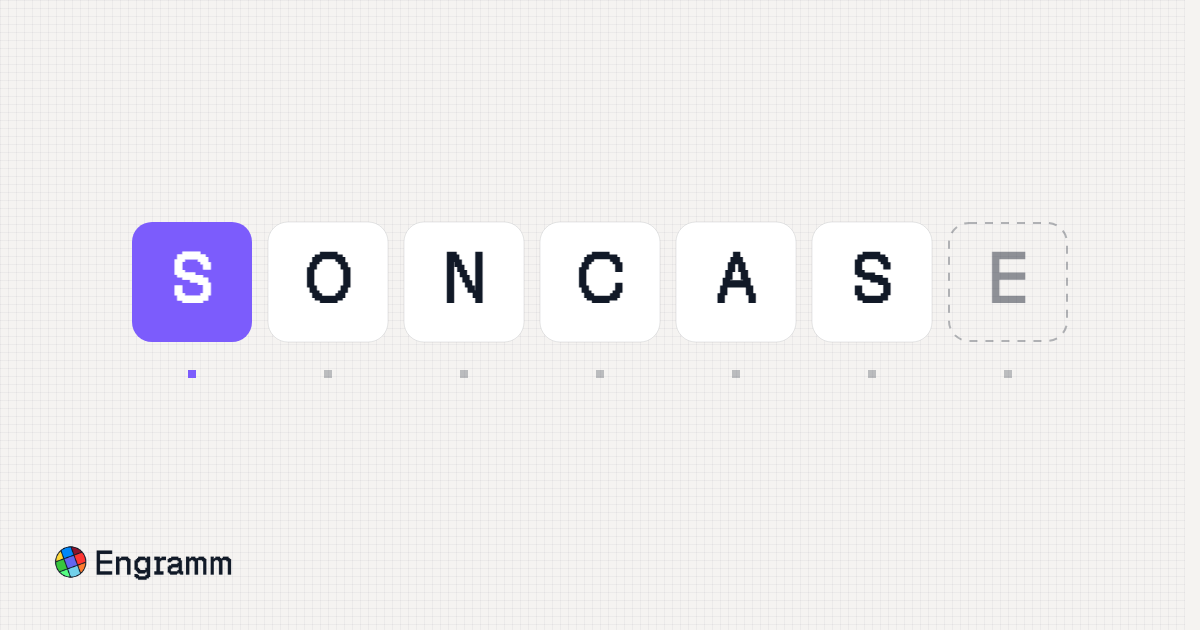
SONCAS is a French acronym. Each letter names a motive that pushes a customer to buy, or not to buy:
- Sécurité (security): avoiding a risk, being reassured;
- Orgueil (pride): being recognized, valued, standing out;
- Nouveauté (novelty): being among the first, trying what just came out;
- Confort (comfort): making life simpler, saving time;
- Argent (money): paying less, earning more, getting a return;
- Sympathie (sympathy): buying from someone you trust.
The SONCASE variant adds an E for Environnement: the environmental and social impact of the purchase, now an explicit criterion in many tenders.
A customer often has a dominant motive and a secondary one. The salesperson's job is to spot them during discovery, then present the offer from the angle that matters to this customer. SONCAS is used with the CAP method (caractéristique, avantage, preuve), which builds each argument in three steps: a feature of the offer, the advantage it brings the customer, and a proof. English-speaking trainers will recognize a close cousin of FAB (features, advantages, benefits).
In short
SONCAS sorts buying motives into six levers, seven with the E of SONCASE. The salesperson spots the customer's dominant motive, then builds the argument with the CAP method.
Where the method comes from.
You often read that SONCAS was created in 1993 by Jean-Denis Larradet, a sales manager at GNFA, the training body of the French automotive industry. The pages that say so cite no source, and the date doesn't hold: in 1992, in Vendeur d'élite (Dunod), Michaël Aguilar already recommends the SONCAS formula and notes that most salespeople have adopted it. The method was widespread before that date, and we found no author for it. The E of SONCASE, for Environment, is an addition you sometimes see, with no known author either.
In English-speaking countries, where SONCAS is little known, people talk about buying motives. The idea of classifying them goes back to the 1920s.
In 1924, Melvin T. Copeland, a Harvard professor, studied 936 advertisements published in American magazines, mostly in 1923, and drew up a list of 33 buying motives, split into emotional and rational ones. Security, comfort, pride and economy in purchase were already on it. Copeland also noted that a good salesperson identifies, consciously or not, the motives they can appeal to.
In short
The SONCAS formula was already widespread in 1992, with no known author. The idea of classifying buying motives goes back to Melvin T. Copeland's work in 1924.
The six motives, with B2B examples.
For each motive: what the customer says when it dominates, a question to check it, and how to frame the argument. The examples take the case of a company choosing new software for its teams.
Security (Sécurité)
- What you hear
- “Who else uses it?”, “What happens if it doesn't work?”, questions about the contract, reversibility and data. The customer has often lived through a project that went wrong.
- Question to ask
- “What could make this project fail, in your view?”
- Argument
- Comparable references, a pilot with one team, contractual commitments, hosting and data protection.
Pride (Orgueil)
- What you hear
- “We're the leader in our market”, the wish to show results to management, interest in what the leading companies in the industry do.
- Question to ask
- “If the project succeeds, what does it change for you and your team?”
- Argument
- The results the project will make visible, companies of the same standing that ran it, the customer's role as the project's champion.
Novelty (Nouveauté)
- What you hear
- “What's new on your side?”, questions about the roadmap, fatigue with current tools.
- Question to ask
- “What's missing today in the tools you use?”
- Argument
- What the offer makes possible that wasn't before, recent releases, the chance to try the next ones.
Comfort (Confort)
- What you hear
- “My teams don't have time”, “We don't want a six-month project”, questions about setup and about who will do the work.
- Question to ask
- “Today, what takes you the most time on this?”
- Argument
- How simple setup is, the support provided, the time saved each week, what stays on the customer's side.
Money (Argent)
- What you hear
- Price asked at the first meeting, price comparisons, questions about return on investment and this year's budget.
- Question to ask
- “How will you judge that this investment paid off?”
- Argument
- Total cost compared with the current situation, measurable gains, payment options. Every figure you put forward has to be backed up.
Sympathy (Sympathie)
- What you hear
- Personal exchanges, interest in the team that will run the project, the weight given to the relationship with current suppliers.
- Question to ask
- “What matters to you in the relationship with a supplier?”
- Argument
- The person who will manage the account, the team's availability, how you'll work together day to day.
Environment, the E in SONCASE
- What you hear
- Questions about CSR policy, environmental criteria in the specifications, requests for a carbon footprint.
- Question to ask
- “Which environmental or social criteria factor into your decision?”
- Argument
- The company's actual commitments, documented: hosting, travel avoided, labels earned. The customer will check them, so they have to be proven.
In short
Each motive shows in what the customer says and can be checked with an open question. The argument is then framed from that motive's angle.
Discovery questions to spot the dominant motive.
You can't guess the dominant motive from one sentence. It emerges over the discovery, in what the customer brings up on their own, what they repeat and what they react to. Open questions help them talk about it:
| Motive | Clues | Question |
|---|---|---|
| Security | Risks, references, contract | “What could make the project fail?” |
| Pride | Company standing, results to show | “What would the project's success change for you?” |
| Novelty | Roadmap, fatigue with current tools | “What's missing today?” |
| Comfort | Lack of time, fear of a heavy project | “What takes you the most time?” |
| Money | Price asked early, comparisons, return | “How will you judge that it paid off?” |
| Sympathy | Personal exchanges, weight of the relationship | “What matters in your relationship with a supplier?” |
| Environment | CSR criteria in the specifications | “Which environmental criteria factor into your choice?” |
A motive you think you've spotted is checked by rephrasing: “If I understand correctly, what matters most to you is taking no risk on the rollout?” The customer's answer confirms the motive or corrects your read.
Template to download: SONCAS discovery sheet and scorecard
Questions by motive, a sheet to fill in during the meeting and the scorecard for the roleplay exercise, as a two-page PDF.
In short
The dominant motive is identified over several exchanges, with open questions, then confirmed by rephrasing.
Several people, several motives.
The method was designed for a single buyer. In B2B, the decision involves several people: according to CEB, now part of Gartner, there were 6.8 on average in 2016, up from 5.4 in 2014. Each has their own motive. For the same training software, for example:
- the training manager looks at the time needed to create content (Comfort);
- IT checks hosting, data security and single sign-on (Security);
- procurement compares total cost and contract terms (Money);
- sales leadership expects results to present to the executive committee (Pride);
- the CSR team, when involved, checks environmental commitments (Environment).
One pitch won't convince everyone. Discovery has to identify each person and their motive, and the final proposal has to answer each of them.
That's the case in complex industrial sales, where Engramm simulations put salespeople in front of a buying committee played by AI.
In short
In a buying committee, each person often has their own motive, and the proposal has to answer each of them.
A motive is not an objection.
An objection is what the customer says; the motive is what drives it. “It's too expensive” sounds like Money. It can also be Security: the customer isn't disputing the price, they doubt they'll get the promised results.
Before answering an objection, look for its cause: “Too expensive compared with what?”, “What would make this price feel justified to you?” Answering a Security objection with a discount lowers the price without removing the doubt. We come back to this in our use case on the price objection.
In short
An objection can hide another motive: “too expensive” sometimes means doubt about results. Look for the cause before answering.
The method's limits.
SONCAS is easy to remember, and that explains its success. Yet six or seven boxes don't cover everything that drives a purchase, and some overlap. Environment, for example, often overlaps with Sympathy or Novelty.
There's also the risk of labeling a customer too fast, on a sentence heard at the first meeting, and choosing the wrong arguments. A profile is confirmed over several conversations. The method says nothing about buying committees either, which are the norm in B2B, and we found no published study measuring its effect on sales.
It remains useful as a listening grid during discovery, provided you combine it with a qualification method and don't force it onto the customer.
In short
SONCAS is a simple listening grid, with no published evidence of its effect on sales. Use it with a qualification method.
Practicing SONCAS in roleplay.
Knowing the six letters isn't enough to spot a motive in a meeting. The skill is built by practicing discovery with a customer who doesn't reveal everything. A simple exercise, in pairs or in a group:
- The trainer prepares several customer profiles, each with a dominant and a secondary motive, without revealing them to the salesperson.
- The salesperson runs ten minutes of discovery, then presents the offer with two or three arguments built with CAP.
- The customer plays the profile: answers open questions, stays vague on closed ones, and raises an objection tied to their motive.
- An observer fills in the scorecard below, then the salesperson says which motive they spotted before the profile is revealed.
- Start again with another profile.
| Criterion | What you observe |
|---|---|
| Open questions | Number of open questions asked during discovery |
| Dominant motive | Did the salesperson identify it and confirm it by rephrasing? |
| Arguments | Each argument links a feature to an advantage for this motive, with a proof |
| Objection | Was the cause of the objection explored before answering it? |
| Listening | Share of talk time left to the customer during discovery |
The exercise takes trainer and participant time, which limits how many rounds you can run. In an AI simulation, each salesperson can do it alone, as often as they want. The character follows the profile, personality and objections set in the scenario, and the conversation is scored on your criteria. Metrics such as the number of open questions or the talk-to-listen ratio are measured in every conversation.
Repeating the exercise a few weeks later matters as much as the first round: without review, what was learned fades quickly, as the forgetting curve describes.
In short
The method is learned in roleplay, against a customer whose motive is hidden, with a scorecard and several rounds.
Frequently asked questions.
What's the difference between SONCAS and SONCASE?
SONCASE adds a seventh motive to SONCAS's six: Environment, meaning the environmental and social impact of the purchase, now an explicit criterion in many tenders. Neither the method nor its variant has a known author.
How do you build a SONCASE profile?
During discovery, note what the customer brings up on their own, what they repeat and what they react to. Identify a dominant and a secondary motive, check them by rephrasing, then build your arguments accordingly. A profile is confirmed over several conversations: one isolated sentence is not enough.
How do you combine SONCAS and CAP?
SONCAS tells you what matters to the customer; CAP structures the argument. For a Security customer, for example: the feature (a pilot with one team), the advantage for them (testing without committing the whole company), the proof (a comparable company that did it this way).
Which sales methods are most widely used?
In France, SONCAS and CAP are widely taught for building arguments. For discovery and qualification, you also find BEBEDC, a French checklist (need, environment, budget, timing, decision-makers, competition), SPIN Selling, which Neil Rackham drew from the study of more than 35,000 sales calls, and MEDDIC, common in B2B software sales.
Sources.
- Michaël Aguilar, Vendeur d'élite, Dunod, 1992, pp. 67-68 (in French): archive.org
- Melvin T. Copeland, Principles of Merchandising, A. W. Shaw, 1924, pp. 155-184, excerpts reprinted in Malcolm P. McNair and Harry L. Hansen (eds.), Readings in Marketing, McGraw-Hill, 1949, pp. 55-59: archive.org
- CEB, “Leading B2B Sales Organizations Challenge, Align & Prescribe To Get Deals Done”, press release, November 21, 2016: prnewswire.com
- Neil Rackham, SPIN Selling, McGraw-Hill, 1988; description of the Routledge reissue: routledge.com
- Lefebvre Dalloz Compétences, “La méthode SONCAS, au plus proche des prospects”, 2021, updated 2026 (in French): formation.lefebvre-dalloz.fr
- Éditions Foucher, “La solution client/usager et l'argumentation” (CAP method), 2023 (in French): foucherconnect.fr