“It's too expensive”: how to train your sales team on the price objection
“It's too expensive.” I've heard it more times than I can count. Many buyers say it almost on principle: they're trained to negotiate and know a salesperson will often give something up if they push. On the other side, many salespeople have never really practiced that moment.

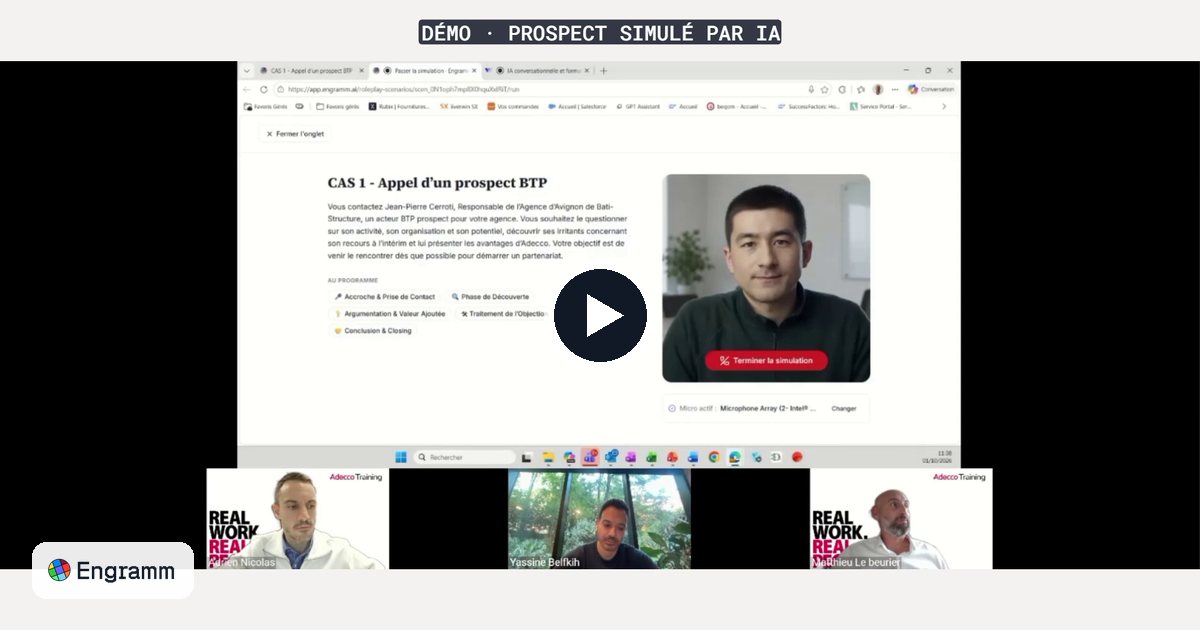
The use case on video, in French.
- Situation
- A buyer disputes the price of a proposal and asks for a discount
- For
- Salespeople, account managers and their managers
- What's evaluated
- Discovery before price, looking for the cause of the objection, concessions and what you get in return
The same scene, every week.
A sales manager who listens back to the team's calls hears it every week. “€48,000 a year, that's too expensive.” And the reply: “If we sign before the end of the month, I can give you 10%.”
Every discount is paid for in margin, and not just at signature. It often becomes the baseline for the renewal, so you pay it again the next year.
To prepare teams, companies usually do three things: a two-day negotiation course, an objection sheet with the right answers, and the Monday morning roleplay between colleagues. Research has looked at these methods, and it doesn't say what you'd expect.
The objection sheet comes too late.
To write SPIN Selling, Neil Rackham and his team analyzed more than 35,000 sales calls. Successful sales had very few objections, and top salespeople didn't handle them better than the others. They got fewer, because they had learned to prevent them.
Many objections arise earlier in the conversation, and it's often the seller who triggers them, by presenting the solution before the customer has expressed a need, or by detailing the offer's features, which makes the customer more price-sensitive. Rackham classifies “it's too expensive” as a value objection: the need wasn't built up enough. In one case he describes, salespeople hired from a cheaper competitor got 30% more price objections than their colleagues, until training in discovery questions brought them down.
An objection sheet trains you to answer at the end of the call, when everything was decided earlier. Our guide to the SONCAS method shows how to look for the motive behind an objection.
Short, spaced-out sessions.
In 1999, John Donovan and David Radosevich pulled together 63 studies on how to distribute practice. Several spaced sessions give better results on average than a single concentrated one, with an effect that varies with the task and the interval between sessions.
For the price objection, a few minutes of practice every week beats a two-day block. It's the principle of spaced reviews, explained in our guide to the forgetting curve.
Feedback on what the salesperson said.
The Monday roleplay often ends with quick feedback from a colleague or the manager, and that feedback doesn't always help. In 1996, Avraham Kluger and Angelo DeNisi pulled together 607 comparisons. On average, feedback improves performance, but in more than a third of cases it lowers it, especially when it targets the person rather than what they did.
“You were a bit soft” helps no one. “You gave the price before knowing what they were comparing it to” says what to change.
Show the good and the bad example.
In 2005, Paul Taylor, Darlene Russ-Eft and Daniel Chan pulled together 117 studies on behavior modeling training, which means showing a way of doing something before practicing it. What's learned transfers better to the job when good and bad examples are shown side by side, when participants practice on situations they wrote themselves, and when their managers take the training too. Setting goals and rewarding the new behavior at work also helps.
These effects on behavior held over time, and sometimes even grew, while the knowledge learned faded.
What AI simulation adds.
There's still a practical problem. To practice every week, each salesperson needs someone to play the buyer. An AI simulation solves that.
At Stanford, Omar Shaikh and colleagues compared two groups in 2024. The first practiced against a conversation partner simulated by AI, the second attended a lecture on the same theory. Placed in a real conflict afterwards, participants in the first group used twice as many cooperative strategies and 67% fewer competitive ones, even though both groups had the same knowledge. The study is small, 40 people, and it's about conflict management, not sales.
The manager keeps the essential part: choosing what to work on, and debriefing.
The price objection in Engramm.
In Engramm, you set up the situation as a scenario: the buyer, their context, budget, negotiating style and the objection they'll raise. The salesperson runs the conversation out loud, then gets a scorecard built on your criteria. For the price objection, you can check, for example:
- whether they explored the need before talking price;
- whether they looked for the cause of the objection before answering it;
- whether they got something in return for each concession.
The AI coach then goes over what was said. On the dashboard, the manager sees who is practicing and on which criteria the team is improving, and chooses what to cover in one-on-ones.

Where to start on Monday.
Take five calls where the customer said “it's too expensive” and listen back to the three minutes before it. You'll know what to practice.
Template to download: price objection scenario sheet and scorecard
A scenario sheet to fill in from your own calls, with the example from this article, then the observer's scorecard with four criteria, as a two-page PDF.
Frequently asked questions.
How do you respond to a customer who says “it's too expensive”?
Start by asking what they're comparing the price to: a competitor, a budget, the current solution, or nothing specific. Then go back to the need and to what the offer changes for them. A discount given right away, with nothing in return, lowers the price without removing the doubt.
Should you offer a discount to close?
A discount is often paid again at renewal, since it becomes the baseline for the next price. If a concession is needed, ask for something in return: a longer commitment, a larger volume or a reference.
How do you train a sales team on the price objection?
Listen back to calls to spot what comes before the objection, then train the team in short, regular sessions, on their own situations, showing good and bad examples, with feedback on what was said rather than on the person. An AI simulation lets each salesperson replay the conversation as often as needed.
Sources.
- Neil Rackham, SPIN Selling, McGraw-Hill, 1988, pp. 2 and 118-135: archive.org
- John J. Donovan and David J. Radosevich (1999), “A meta-analytic review of the distribution of practice effect: Now you see it, now you don't”, Journal of Applied Psychology, 84(5), 795-805: doi.org
- Avraham N. Kluger and Angelo DeNisi (1996), “The effects of feedback interventions on performance: A historical review, a meta-analysis, and a preliminary feedback intervention theory”, Psychological Bulletin, 119(2), 254-284: doi.org
- Paul J. Taylor, Darlene F. Russ-Eft and Daniel W. L. Chan (2005), “A meta-analytic review of behavior modeling training”, Journal of Applied Psychology, 90(4), 692-709: pubmed.ncbi.nlm.nih.gov
- Omar Shaikh, Valentino Chai, Michele J. Gelfand, Diyi Yang and Michael S. Bernstein (2024), “Rehearsal: Simulating Conflict to Teach Conflict Resolution”, CHI 2024: arxiv.org