How to handle objections in sales: a five-step method and the most common B2B objections
An objection is a concern a prospect raises before committing, about price, timing, need, the current vendor or risk. Objection handling means finding the cause of the concern before answering, then checking that the answer resolved it.


What an objection is.
An objection is a concern a prospect raises during the conversation that delays or blocks their decision. It can be about the offer, its price, the timing, the people who need to sign off or the risk of changing what is already in place, and it can come up at any stage of the sale, starting with the first prospecting call.
It tells you what the prospect needs in order to move forward: proof, a comparison, a colleague's approval, time. If the salesperson answers right away with an argument, they never find out, and the prospect ends up defending their position instead of explaining it.
“It's too expensive” can come from a comparison with a competitor, a budget that is already spent or a doubt about results, and each of these causes calls for a different answer. So the method below puts questions before any answer.
In short
An objection is a concern that delays the prospect's decision. The same sentence can have several causes, which you need to identify before answering.
Objection, excuse or condition.
What a prospect says to avoid moving forward isn't always an objection. It can also be an excuse or a condition, which are handled differently.
An objection is a sincere concern, which the prospect would drop if they got the right answer, and it is what the five-step method is for. An excuse is a way to end the conversation without giving the real reason, like the “just send me some information” that comes thirty seconds into a cold call, and it doesn't hold up to a specific question.
A condition is a real constraint the salesperson cannot remove: a budget frozen until the next fiscal year, a running contract with the current vendor, a regulatory requirement. Rather than pushing back, which damages the relationship, the salesperson verifies it, then prepares for the deadline and for what it will take to be chosen at that point.
| Case | Example | How to recognize it | What the salesperson does |
|---|---|---|---|
| Objection | “Rolling this out would take us too much time.” | The prospect explains the concern when asked | Looks for the cause, answers, checks |
| Excuse | “Just send me some information.” | The answer stays vague, the reason changes from one question to the next | Looks for the real reason, or offers to reconnect later |
| Condition | “Our current contract runs until June.” | The fact is specific and can be verified | Verifies it and prepares for the deadline |
In short
Before answering, find out whether the prospect is expressing a sincere concern, an excuse to end the conversation or a constraint no one can remove. Objection handling applies to the first case.
How to handle objections in five steps.
These steps come up, under different names, in many sales methods. They force the salesperson to slow down just when they want to answer fast. Take the operations director of a facilities maintenance company who, at the end of a meeting, tells a salesperson pitching field service scheduling software: “It's not the right time. We'll look at it next year.”
Listen without interrupting
- What the salesperson does
- Lets the prospect finish, then pauses before speaking. Notes the exact words, which will be used to rephrase.
- In the example
- Picks up “not the right time” and “next year,” and lets a silence pass. The prospect adds: “We've already got a lot on our plate.”
- Common mistake
- Answering before the sentence is over, or getting defensive.
Rephrase
- What the salesperson does
- Restates the objection in their own words, without judging it, and waits for the prospect to confirm or correct.
- In the example
- “So if I'm hearing you right, you like the tool, but taking on one more project right now is a lot?” The prospect confirms.
- Common mistake
- Downplaying the objection (“it's just a scheduling question”) or reading into it something the prospect didn't say.
Ask questions to find the cause
- What the salesperson does
- Asks one or two open questions to find out what is behind the objection.
- In the example
- “What's making it tough right now?” The prospect answers: “We're bringing on 200 technicians after an acquisition, and my team is underwater.”
- Common mistake
- Firing questions like an interrogation, or asking a closed question that invites a no.
Answer the cause
- What the salesperson does
- Answers the cause they found, with one argument and supporting proof, without running through the whole pitch.
- In the example
- “If your team is tied up with the integration, we can start with a single branch, and we do the setup. I've got a customer about your size who did it that way. I can show you.”
- Common mistake
- Answering the original sentence, “it's not the right time,” instead of the cause.
Check
- What the salesperson does
- Asks whether the answer resolves the concern, then proposes a specific next step.
- In the example
- “Does that take care of your concern about your team's workload?” If the prospect says “partly,” the salesperson asks what's still holding them back and goes back to step 3.
- Common mistake
- Moving on without checking, or taking a polite “yes” for agreement.
In 2019, Omar Itani, Emily Goad and Fernando Jaramillo pulled together about twenty years of research on salesperson listening in a meta-analysis. They link listening to both the quality of the relationship and sales results, partly because it helps salespeople adapt what they say to what the customer is asking for.
In 2014, Harry Weger and his colleagues tested rephrasing by having 115 students talk with partners trained to respond in one of three ways: by rephrasing and asking follow-up questions, by giving advice, or with simple acknowledgements. Students whose words had been rephrased felt more understood than the others. Advice made the conversation just as satisfying, without the same feeling of being understood. The study looked at conversations between students; in a sale, the salesperson who answers an objection without rephrasing it is in the position of the partners who gave advice.
In France, sales courses often teach these steps under the acronym CRAC: creuser, reformuler, argumenter, contrôler (dig, rephrase, argue, check). We could not find who created it. CRAC puts the questions before the rephrasing, and in a real meeting the salesperson goes back and forth between the two several times anyway before answering. If the check brings up a new concern, they start again at step 2.
In short
Listening and rephrasing show the prospect they have been understood. Questions help find the cause of the objection, which the salesperson answers before checking that the doubt is resolved.
The most common sales objections in B2B.
The table covers eight of the most common sales objections in B2B, with sample answers based on the field service scheduling software example.
| Objection | What it often hides | Question to ask | Sample answer |
|---|---|---|---|
| “It's too expensive.” | A comparison with a competitor, a budget or the current solution, or a doubt about results | “Too expensive compared to what?” | “If the gap is the setup, which we include, we can look together at what it would cost you to do it in-house.” |
| “We don't have the budget.” | Budget already allocated elsewhere, a topic not seen as a priority, or a budget that is actually frozen | “How do purchases like this get decided on your end, and when in the year?” | “We could put the business case together for the January budget review. What numbers is your leadership going to want to see?” |
| “It's not the right time.” | A swamped team, another priority project, fear of a heavy rollout | “What's making it tough right now?” | “If the ERP rollout comes first, we can time the kickoff for when it wraps up. When's that scheduled?” |
| “We don't need it.” | A problem the prospect doesn't see, or discovery that was too short | “How are you handling it today, and what bugs you most about it?” | “Earlier you said your technicians call dispatch five or six times a day. Are you OK with that?” |
| “I need to talk to my boss.” | Someone who doesn't decide alone, or who isn't sure they can defend the project | “Who else is in the loop, and what's each of them going to look at?” | “Want to work on what you'll show them together?” |
| “We already work with someone.” | Real satisfaction, or the work and risk a switch would involve | “What's working well with them, and what could work better?” | “Keep your current tool. We run a trial at one branch, just for emergency calls, and you compare.” |
| “Just send me some information.” | Often an excuse to end the call, sometimes real interest | “Sure. So I don't send you the whole catalog, what's on your plate right now?” | “I'll send you two pages on that tonight. Can we talk for ten minutes on Thursday?” |
| “What happens if it doesn't work for us?” | A past project that went badly, fear of being held responsible | “Six months from now, what would make you say it failed?” | “Then let's use those criteria for the pilot, and check in after a month.” |
Each answer assumes the question has confirmed the cause. Otherwise, it answers an objection the prospect may not have.
Price objections
When the price objection comes up, the temptation is to offer a discount before knowing what the prospect is comparing to. If it's a competitor, first check that both offers cover the same scope; if it's a budget, the discussion is about timing and internal approval. A prospect who isn't comparing to anything specific often doubts the results. The use case on handling the “it's too expensive” objection covers this moment in detail, and how to prepare a team for it.
The answer also depends on what drives the buyer: a buyer focused on security will be reassured by a pilot and references, a buyer focused on money by a total cost calculation. The guide to the SONCAS method shows how to spot these buying motives during discovery.
The current vendor and timing
“We already work with someone” and “it's not the right time” often come from the same tendency to keep what is already in place. In 1988, economists William Samuelson and Richard Zeckhauser observed it in a series of decision-making experiments, then in the real choices faculty members made between health plans and retirement programs. People stuck with the option already in place disproportionately, including for important decisions. The two authors called it status quo bias.
For the buyer, switching vendors takes work and carries a risk, especially for the person championing the project internally. A trial limited to one team or one branch reduces both.
The missing decision-maker
A prospect who says “I need to talk to my boss” is often telling the truth. According to a Gartner survey of 632 B2B buyers conducted in 2024, buying groups range from five to 16 people across as many as four functions. In 74% of these groups, conflict hurts the decision (different objectives, disagreement on the best course of action, a decision overruled by decision-makers outside the group), and groups that reach consensus are 2.5 times more likely to report that the deal they closed was high-quality.
That prospect then has to convince people who each have their own criteria, and the salesperson can help. They ask who is involved in the decision and what each person will look at, then prepare the internal presentation with their contact, or offer to present it alongside them. In industrial sales, the buyer, the technical director and executive leadership each have their own objections; with Engramm's simulations for manufacturing, the salesperson rehearses the meeting with each of these profiles.
“Just send me some information”
This request mostly comes up on the phone, during prospecting, when the prospect wants to hang up politely. If they give no lead at all when asked what's on their plate, it was an excuse, and the salesperson notes it in the CRM rather than following up every week.
In short
Each common objection can have several causes. An open question brings out the right one, and the answer takes into account both that cause and what drives the buyer.
Build your team's objection handling sheet.
For your team's sheet, start from the objections they hear, in your prospects' own words. Listen back to about ten recent calls or meetings, ask each salesperson for the three objections they find hardest, and pull the loss reasons for the year's lost deals from the CRM.
For each objection, the sheet uses the four columns of the table and adds a fifth for the proof to bring: a customer story, a verifiable figure, a demo. Keep one row per objection, about ten rows to start, and answers short enough that anyone can reread the sheet in two minutes before a meeting.
A pharmaceutical sales rep's sheet is mostly clinical objections, from specialists who know existing treatments well; Engramm's simulations for medical sales recreate these situations.
In every job, the sheet grows as meetings go by, when a new objection keeps coming up or an answer doesn't land.
Template to download: objection handling sheet
The five steps, the eight common objections with the question to ask and a sample answer, a blank sheet for your team's own objections and the roleplay scorecard, as a two-page PDF.
In short
The sheet starts from the objections the team hears, in the prospects' own words, and adds the proof to bring for each one. It starts at about ten rows and grows as meetings go by.
Train your team to handle objections.
When the prospect says “it's too expensive,” the salesperson has a few seconds to react. They do better if they have already said their answer out loud, in a roleplay, before the meeting.
In 2005, Paul Taylor, Darlene Russ-Eft and Daniel Chan reviewed 117 studies of behavior modeling training, which shows a way of doing something before having people practice it. Skills improved most when the learning points were presented as rules to follow. What was learned carried over better to the job when participants practiced on scenarios they had come up with themselves. In an objection handling workshop, the sheet serves as the rules, and each person brings an objection they've heard.
The exercise works in groups of three:
- Each participant writes on a card an objection they heard recently, what it was hiding and what would have convinced the prospect.
- One participant plays the prospect using someone else's card, the second plays the salesperson, the third observes with the scorecard below.
- The conversation lasts five minutes. The prospect only reveals the cause of the objection if asked with an open question.
- The observer gives feedback criterion by criterion, quoting specific lines from the conversation. Then the roles rotate.
- The following week, the group goes back to the objections that were handled worst, with a prospect who is more rushed or more closed off.
| Criterion | What you observe |
|---|---|
| Listening | The salesperson lets the prospect finish and pauses before answering |
| Rephrasing | They rephrase without judging, and the prospect confirms |
| Questions | They ask at least one open question before answering and find the cause of the objection |
| Answer | The answer addresses that cause and is backed by proof |
| Check | They check that the concern is resolved and propose a next step |
| Composure | They keep the same tone and pace as before the objection, without getting defensive |
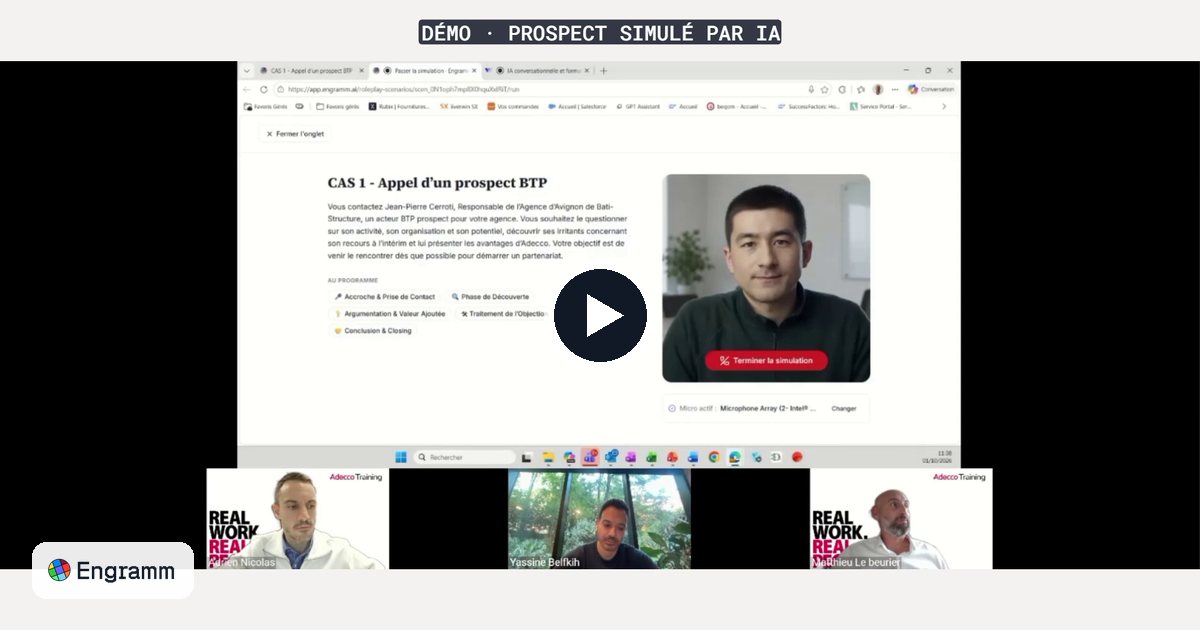
In a workshop, each round takes three people, and the colleague playing the prospect often knows the expected answer. In Engramm's AI roleplays, you describe for each objection the prospect, their context and the cause they only reveal if the salesperson looks for it. The salesperson practices alone, out loud, with a prospect who responds in under 500 ms. Variants of the scenario change the prospect's profile, from an open buyer who lets you talk to a wary buyer already using a competitor.
The scorecard uses your criteria, for example the ones above, and the AI coach reviews with the salesperson what they said. On their dashboard, the manager sees which scenarios, and therefore which objections, get the team's lowest scores, and focuses the next group session on them.
In short
Objection handling is practiced out loud, on the team's real objections, with a scorecard built on the five steps. The exercise is repeated week after week, with tougher prospects.
Frequently asked questions.
What is objection handling?
Objection handling is how a salesperson responds when a prospect raises a concern that delays or blocks the decision: price, timing, need, the current vendor, who decides, or risk. It means finding the cause of the concern before answering, then checking that the answer resolved it.
What are the three types of objections?
An objection is a sincere concern the prospect would drop with the right answer. An excuse is a way to end the conversation without giving the real reason. A condition is a real constraint the salesperson cannot remove, such as a frozen budget or a contract that is still running. Only the first one is a matter for objection handling.
What are the 5 steps of objection handling?
Listen without interrupting, rephrase the objection, ask questions to find its cause, answer that cause with proof, then check that the concern is resolved. In France, sales courses often teach a four-step version called CRAC: dig, rephrase, argue, check.
How do you handle price objections?
First ask what the prospect is comparing the price to: a competitor, a budget, the current solution, or nothing specific. Then answer that cause, with a like-for-like comparison, a total cost calculation or proof of results. Avoid offering a discount before you have found the cause.
Sources.
- Omar S. Itani, Emily A. Goad and Fernando Jaramillo (2019), “Building customer relationships while achieving sales performance results: Is listening the holy grail of sales?”, Journal of Business Research, 102, 120-130: ideas.repec.org
- Harry Weger Jr., Gina Castle Bell, Elizabeth M. Minei and Melissa C. Robinson (2014), “The relative effectiveness of active listening in initial interactions”, International Journal of Listening, 28(1), 13-31: doi.org
- digiSchool, “La vente – Argumentation et traitement des objections” (CRAC method, in French): digischool.fr
- William Samuelson and Richard Zeckhauser (1988), “Status quo bias in decision making”, Journal of Risk and Uncertainty, 1, 7-59: doi.org
- Gartner, “Gartner Sales Survey Finds 74% of B2B Buyer Teams Demonstrate ‘Unhealthy Conflict’ During The Decision Process”, press release, May 7, 2025: gartner.com
- Paul J. Taylor, Darlene F. Russ-Eft and Daniel W. L. Chan (2005), “A meta-analytic review of behavior modeling training”, Journal of Applied Psychology, 90(4), 692-709: pubmed.ncbi.nlm.nih.gov