How to write a cold calling script: five steps, a template and how to practice
A sales script is the outline a salesperson follows on a call. A cold calling script is written to get a first meeting with someone who wasn't expecting the call, in five steps: the opening, the reason for the call, one or two questions, a bridge from the prospect's answer, and the meeting request. We go through each step with a template to adapt, then gatekeepers, first-call objections, timing, the rules in France and practice.

What cold calling is.
Sales prospecting covers everything a salesperson does to open new accounts: emails, LinkedIn messages, trade shows, referrals and calls. Cold calling is the most direct of these. The salesperson calls a company that isn't expecting them, and the prospect decides within seconds whether to stay on the line.
In B2B, the goal of a cold call is a meeting, by video or in person, with the person who handles the topic. When that isn't possible right away, the call gathers what you need to call back at the right time: that person's name, the equipment in place, the end date of the contract with the current supplier.
Bogdana Humă and Elizabeth Stokoe, who study conversation, analyzed 150 of these calls, recorded in 2015 and 2016 by three British companies that lease printers and phone systems. Almost every organization they called already had a contract with a competitor. On a first call, the salesperson mostly gathered information and set up a next contact. On follow-up calls, the whole conversation worked toward booking a meeting.
In short
A cold call aims for a meeting with the person who handles the topic. A first call often gathers information and sets up the next one.
Preparing the call.
Before dialing, the salesperson should be able to say in one sentence why they are calling this company now. The most useful reason comes from what is happening at the prospect's company: a hiring push announced on LinkedIn, a new site, a contract signed three years ago with a competitor, a regulation changing in their industry. That sentence becomes step two of the script.
Next comes the name of the person to reach, from the company website, LinkedIn or the CRM if a colleague has called before. A name also makes it easier to get past the switchboard.
Last, the salesperson sets a goal, a 20 to 30-minute meeting on a specific date, and a fallback goal in case it fails: the right person's name, the end date of the current contract or agreement to a callback on a set date. The result goes into the CRM with the date of the next call.
Emma, an account executive at a commercial van leasing company, is preparing a call to the CFO of an 80-person construction company that just opened a branch in Denver. Her prep sheet fits in six lines, and the examples below follow her call.
| To prepare | For Emma's call |
|---|---|
| Reason for the call | The company is opening a branch in Denver and hiring site supervisors |
| Person to reach | Tom Garner, CFO, listed on the company website |
| Goal | A 20-minute video meeting the following week |
| Fallback goal | The end date of the current lease, and agreement to call back a month before |
| Questions | How the Denver crews will be equipped; who manages the vehicles today |
| Likely objections | “We already have a leasing company,” “Send me a brochure” |
In short
Before calling, the salesperson prepares a reason tied to what is happening at the prospect's company, the name of the person to reach, a meeting goal and a fallback goal.
A cold calling script in five steps.
Each step of a sales call script takes one or two sentences. From the third step on, the prospect should be doing most of the talking.
The opening
- What the salesperson does
- States their first name, last name, company and what it does, then checks that the prospect has two minutes.
- Example
- “Hi Mr. Garner, this is Emma Clark with [company]. We lease work vans to construction companies. Do you have two minutes?”
- Avoid
- A “How are you today?” to a stranger, or a first name alone, as if the prospect knew you.
The reason for the call
- What the salesperson does
- Ties the call to the prospect's situation before talking about the offer.
- Example
- “I saw you're opening a branch in Denver. That's often when the companies we work with take another look at their vans.”
- Avoid
- A minute-long introduction of your company, its customers and its products.
The questions
- What the salesperson does
- Asks one or two open questions about the prospect's situation and lets them answer.
- Example
- “How are you planning to equip the Denver crews?” then “Who handles the vehicles for you today?”
- Avoid
- A closed question that invites a no, such as “Do you need any vans?”
The bridge
- What the salesperson does
- Picks up what the prospect just said and connects it to the next step.
- Example
- “So your current lease ends in June, and you'll need six more vans for Denver. Those are two things we could look at together in 20 minutes.”
- Avoid
- Moving straight to the meeting request without using the answer.
The meeting request
- What the salesperson does
- Proposes a short meeting with two specific time slots, then confirms it in writing the same day.
- Example
- “How about 20 minutes by video, Tuesday at 10 or Thursday at 2? Which works better for you?”
- Avoid
- “Can I send you a brochure?”, which swaps the meeting for a document.
On the opening, Humă and Stokoe found that in 32 of the 41 first calls in their data, the salesperson introduces themselves as if the other person already knew them, with a first name and a company name (“It's Kathryn calling from Ladybird,” names changed by the researchers). The format comes from conversations between people who know each other, and the researchers suspect it now signals a sales call.
In another analysis of 153 calls, with Rein Ove Sikveland, they describe two practices among salespeople asking for a meeting. They lead into the request with explanations that get the prospect to accept the idea before it is spelled out, then present the meeting as a small ask, which leaves little room to refuse. In the script, the reason for the call and the bridge lead into the request, and 20 minutes by video, at one of two time slots, keeps it small.
In short
The script follows five steps: the opening, the reason for the call, the questions, the bridge and the meeting request. The reason for the call and the bridge lead into the request, which should stay small.
How to create a sales script.
In this sales script template, the opening and the meeting request are written word for word. The questions and the bridge, which depend on the prospect's answers, are written as prompts.
| Step | What you say | What to adapt |
|---|---|---|
| Opening | “Hi [first and last name], this is [your name] with [company]. We [what your company does, in one sentence]. Do you have two minutes?” | The tone, depending on the industry and the person's role |
| Reason for the call | “I'm calling because [specific fact about the prospect's company]. [What you do for companies in that situation].” | One reason per type of situation: hiring, new site, contract renewal, regulation |
| Questions | “How do you handle [topic] today?” “What gives you the most trouble with [topic]?” | Two questions at most, with a version for each role you call |
| Bridge | “So you're saying [the prospect's own words]. That's what we look at with [similar customers].” | The prospect's exact words |
| Meeting request | “How about [length] by video, [day and time] or [day and time]? Which works better?” | Length and format, depending on your sales cycle |
| Fallback | “Understood. So I can call you back at the right time, when does your current contract end?” | The information you chose as your fallback goal |
Humă and Stokoe did not know whether the salespeople in their data followed a script. In first calls, they found no fixed order: after gathering information, the salesperson moves between tasks depending on the prospect's answers. They conclude that a rigid structure imposed by a script might hold salespeople back when prospects push back. The CROC method offers a four-step call plan instead.
To write yours, listen again to about ten of your team's calls, keep the sentences that got an answer and note the ones that came right before a no. Write one reason for calling per type of situation and a version of the questions for each role, since a CFO and a branch manager don't talk about vans in the same terms. Our guide to the elevator pitch helps write the reason for the call. Then read the script out loud and shorten any sentence that makes you stop for breath.
Template to download: cold calling script
The five steps with lines to fill in, the call prep sheet, answers to first-call objections and the practice scorecard, as a two-page PDF.
In short
The script spells out the opening and the meeting request, and gives prompts for the rest. It starts from real calls and lets the salesperson follow the prospect when the conversation shifts.
Getting past the gatekeeper.
In B2B, a call often goes through a switchboard, a front desk or an assistant before it reaches the right person. In Humă and Stokoe's data, that was the case for most calls.
The researchers describe two ways of asking for the person. On a first call, the salesperson describes them by their role (“the person who would deal with the print management for the office”), and the receptionist decides whom to transfer the call to. On follow-up calls, the salesperson asks for the person by first name, without introducing themselves, which discourages questions.
Ask for the person by the name you found during prep, along with their role, and say who you are and why you're calling if asked. Pretending to know someone you have never spoken to, or inventing an urgent matter, starts the relationship with a lie the prospect will discover as soon as they pick up.
Without a name, simply ask the receptionist who handles the company's vehicles. The answer gives you a name, sometimes the best time to reach that person, both worth logging in the CRM. If the person is out, ask when to call back.
In short
Most B2B calls reach a receptionist first. The salesperson asks for the person by name, says honestly who they are, and uses the receptionist to find the right person and the right time.
First-call objections.
On a first call, the prospect didn't ask for anything and often tries to cut the call short. In a 2023 paper based on 159 calls, Humă and Stokoe identify two forms of resistance. With a block, the prospect stops the sale: they say the purchase is unnecessary or premature (“our contract runs for another three years”) and move to end the call. A stall slows the sale without turning it down, through an email instead of a meeting, a call in a few months or a decision that depends on colleagues. Faced with a stall, the salespeople in their data avoided refusing outright and proposed a faster next step. Calling back a prospect who stalled is a matter of sales follow-up.
| What the prospect says | What it often means | A possible answer |
|---|---|---|
| “I don't have time.” | A bad moment, or a way to test your reason for calling | “I'll be quick: I'm calling about your Denver branch. Do you have a minute now, or should I call you Thursday at 9?” |
| “I'm not interested.” | A reflex, before hearing why you're calling | “I was calling about your new branch. Is the vehicle question settled there, or still open?” |
| “Send me a brochure.” | A stall, sometimes real interest | “I'll send it tonight. So I can pick the two pages that matter to you, do you lease or buy your current vans?” |
| “We already have a leasing company.” | Real satisfaction, or the comfort of not changing anything | “Most companies I call do. When does your current contract end?” |
| “Call me back in six months.” | A genuine delay, or a polite no | “Sure. What will have changed in six months, so I can call you at the right time?” |
| “How did you get my number?” | A fair question, sometimes irritation | Say where the number came from (company website, switchboard, database) and offer to stop calling if the person prefers. |
Each of these answers assumes you have understood what lies behind the objection. The guide on handling objections in five steps covers the method.
In short
On a first call, the prospect either blocks (no need, not now) or stalls (an email, a call in six months). Faced with a stall, the salesperson proposes a faster next step, with an answer ready for each common objection.
The best time to cold call.
We found no published study on the best time for a B2B cold call. The most cited one was presented in 2007 by InsideSales.com, a sales software company, and James Oldroyd, then on the faculty of MIT's Sloan School of Management. It covers people who had filled out a contact form: six companies, more than 15,000 leads and more than 100,000 call attempts. Wednesday and Thursday produced the most contacts, and the 4 to 6 p.m. slot a little over twice as many as 11 a.m. to noon. Speed mattered more: the odds of reaching the person dropped more than tenfold within the first hour after their request.
These figures are about inbound leads, in the US, nearly twenty years ago. For your cold calls, your CRM or dialer will show connect rates by day and hour after a few weeks. When calling consumers in France, the law sets the time slots anyway.
In short
No published study measures the best time for a B2B cold call. The most cited one covers inbound leads; your own connect rates by time slot are a better guide.
Cold calling rules in France.
If your team calls into France, the rules depend on whether you call a consumer or a business. Other countries have their own rules; this section covers France only. Since August 11, 2026, it has been illegal to cold call a consumer who has not given prior consent. The rule comes from article 13 of the law of June 30, 2025 against fraud involving public aid, which rewrote article L. 223-1 of the French Consumer Code. Consent must come from a clear affirmative act, lasts one year at most and can be withdrawn at any time, including verbally. Two exceptions remain: calling a customer about an existing contract, and selling newspaper or magazine subscriptions. The Bloctel do-not-call list ended on the same date. Allowed calls take place Monday to Friday, excluding public holidays, from 10 a.m. to 1 p.m. and 2 to 8 p.m.
For calls to businesses, the CNIL, France's data protection authority, accepts that prospecting can rest on the caller's legitimate interest when the call relates to the person's job. Its example is software presented to a company's IT director. The person must have been told that their number could be used for prospecting and be able to opt out easily. Each call must let them know which organization is calling and refuse further calls.
For a team calling French businesses, the salesperson names their company in the opening, calls people whose role relates to what they sell, says where the number came from if asked, and logs every opt-out request in the CRM. This summary is not a substitute for legal advice.
In short
Since August 11, 2026, calling a consumer in France requires prior consent. Calls to businesses remain allowed if they relate to the person's job, and the person must know who is calling and be able to opt out.
Practicing cold calls.
On the phone, the salesperson has a few seconds to react to “I don't have time,” without seeing the other person. Those answers are learned out loud, before live calls, for example in this half-hour exercise for three people.
- Each participant writes a prospect card based on a recent call: the company, the person's role, their first answer, and what they only reveal if asked, such as when their contract ends.
- One participant plays the prospect using someone else's card, the second makes the call, the third observes with the scorecard. The first two sit back to back.
- Every other round, the call starts with the receptionist, who asks what the call is about before transferring it.
- After three to five minutes, the observer gives feedback on two points, quoting what was said, and the roles rotate.
| Criterion | What to observe |
|---|---|
| Opening | First name, last name, company and what it does, in one sentence; the salesperson checks the prospect can talk |
| Reason for the call | Tied to the prospect's situation, before any pitch |
| Questions | One or two open questions; the prospect talks more than the salesperson |
| Bridge | The prospect's words are picked up to lead to the next step |
| Objection | A question before answering; a next step proposed when the prospect stalls |
| Close | A meeting on a set date, or the fallback goal reached and logged |
Our guide to sales roleplay scenarios includes a ready-to-run cold calling scenario.
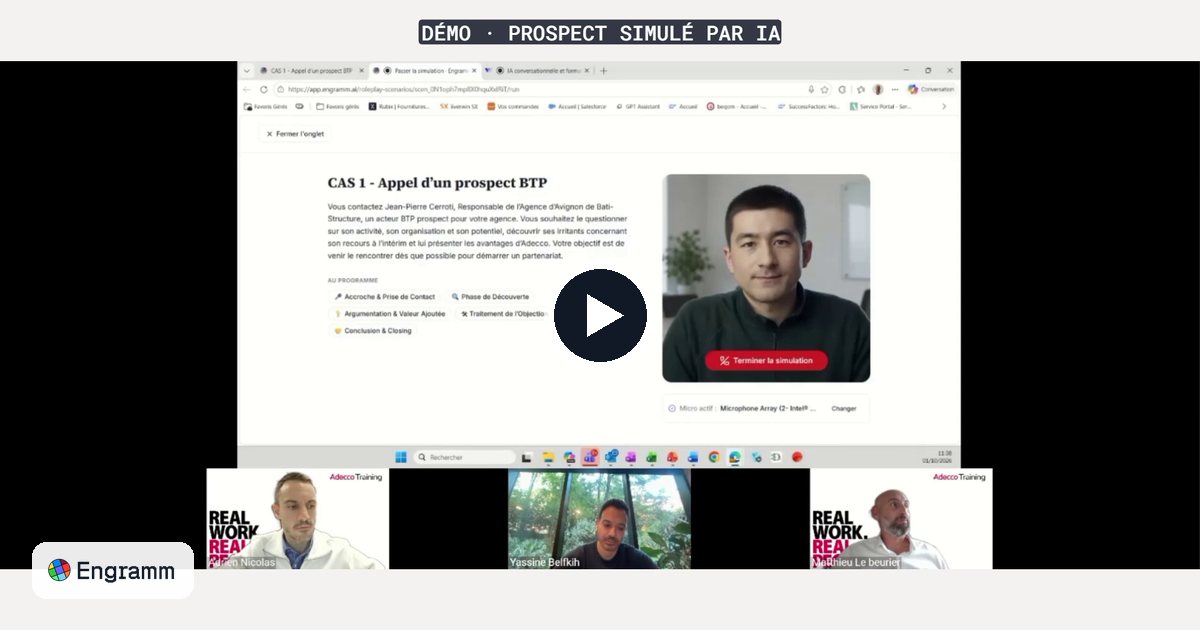
Among colleagues, each round takes three people, which limits how many calls each person rehearses. In an AI roleplay of the call, the scenario starts from your script and objection sheets: the prospect, their first answer, their objection and what they only reveal if asked. Variants add the assistant who screens calls, the executive in a hurry or the prospect already working with a competitor, at increasing difficulty. The character answers in under 500 ms, a scorecard grades the call on the criteria in your rubric, and the dashboard shows managers at which step each rep loses points.
Adecco trained 65 salespeople this way. They call companies that often already work with another staffing agency, and after half a day in the classroom they practiced on six prospect profiles drawn from real situations. With the same number of meetings, they produced 6% more sales proposals, as Adecco explained in our webinar on conversational AI and training.
In short
Cold calling is learned out loud, through short calls played in threes and graded with a rubric that follows the script. An AI roleplay lets each salesperson redo the call alone, with prospects that get harder over time.
Frequently asked questions.
What is a sales script?
A sales script is the outline a salesperson follows on a call: how to open, why they are calling, which questions to ask and how to ask for the next step. For cold calling, the opening and the meeting request are written word for word, and the questions are written as prompts the salesperson adapts to the prospect's answers.
What is the best time to cold call?
No published study measures it for B2B cold calls. A 2007 study of inbound web leads found the most contacts on Wednesdays and Thursdays, between 4 and 6 p.m. The safest approach is to track connect rates by time slot on your own calls.
How do you get past the gatekeeper?
Ask for the person by name and role, and say who you are if asked. Without a name, ask the receptionist who handles the topic and when to reach them. Avoid fake urgency: the prospect sees through it as soon as they pick up.
Is cold calling legal in France?
Calling consumers in France has required their prior consent since August 11, 2026. According to the CNIL, the French data protection authority, calls to businesses remain allowed when they relate to the person's job, provided the person was informed and can easily opt out.
Sources.
- Bogdana Humă and Elizabeth Stokoe (2020), “The anatomy of first-time and subsequent business-to-business ‘cold’ calls,” Research on Language and Social Interaction, 53(2), 271-294: ray.yorksj.ac.uk
- Bogdana Humă, Elizabeth Stokoe and Rein Ove Sikveland (2019), “Persuasive conduct: Alignment and resistance in prospecting ‘cold’ calls,” Journal of Language and Social Psychology, 38(1), 33-60: research.vu.nl
- Bogdana Humă and Elizabeth Stokoe (2023), “Resistance in business-to-business ‘cold’ sales calls,” Journal of Language and Social Psychology, 42(5-6), 630-652: researchonline.lse.ac.uk
- InsideSales.com and James Oldroyd, “Lead Response Management Study,” presented October 16, 2007, summary published by InsideSales.com (2008 copy): mortech.com
- Law No. 2025-594 of June 30, 2025 against fraud involving public aid, article 13 (in French): legifrance.gouv.fr
- Service Public Entreprendre (French government), “Démarchage téléphonique interdit : quelles sont les nouvelles règles ?”, updated August 11, 2026 (in French): entreprendre.service-public.gouv.fr
- CNIL, “Prospection commerciale par téléphone (hors automate d'appel) : quelles sont les règles ?” (in French): cnil.fr