Trade show lead qualification: how to train your sales reps before the event
A visitor stops at your booth and stays a few minutes. Trade show lead qualification means finding out in that time whether they have a project, by when and who decides, then booking a meeting or letting them move on.

- For
- Sales reps, business developers and everyone working the booth
- Duration
- 3 to 5 minutes per round, in the days before the show
A few minutes at the booth.
A trade show is one short conversation with a stranger after another. A visitor stops because a screen or a word on the booth catches their eye, and walks away as soon as someone starts reciting the brochure. We saw it at our VivaTech 2026 booth: over three days and hundreds of conversations, visitors wanted to try the product rather than watch a demo.
Booth conversations tend to stall at the same points. The rep opens with “Can I help you?”, which invites a “No thanks, just looking.” If the visitor stays, the rep fires off questions like a form, or pitches the whole offer without knowing what the visitor cares about. The conversation ends with a scanned badge and a promise to “stay in touch.”
After the show, the team comes home with a list of contacts and no idea which ones have a project. Everyone gets the same email, including the few visitors who had a real need.
In short
At the booth, the rep has a few minutes to hold a visitor's attention and find out whether there is a project. Without qualification, the show's contact list doesn't say whom to call first.
What research says.
In 2004, Timothy Smith, Srinath Gopalakrishna and Paul Smith published a field study with industrial distributors on what trade shows add to personal selling. Follow-up sales calls were more productive with customers who had already seen the product at the show, and the show improved purchase intentions. Profits were highest when the show was paired with the right level of sales effort.
For the show to set up the sales call that follows, every booth conversation should tell the rep whom to call first, and with what.
In short
According to this study, sales calls are more productive with customers who saw the product at a trade show. The booth conversation should prepare that call.
The scenario to roleplay.
The qualifying questions can follow the BANT sales methodology: need, timeline, who decides and budget. At a booth, it's better to keep the budget question for the next meeting, and the other three are enough to decide on a next step. For a complex sale, full qualification with the criteria of MEDDPICC can wait for the first meeting. The pitch itself fits in one or two sentences, like an elevator pitch fitted to the visitor's problem.
The visitor
- Who she is
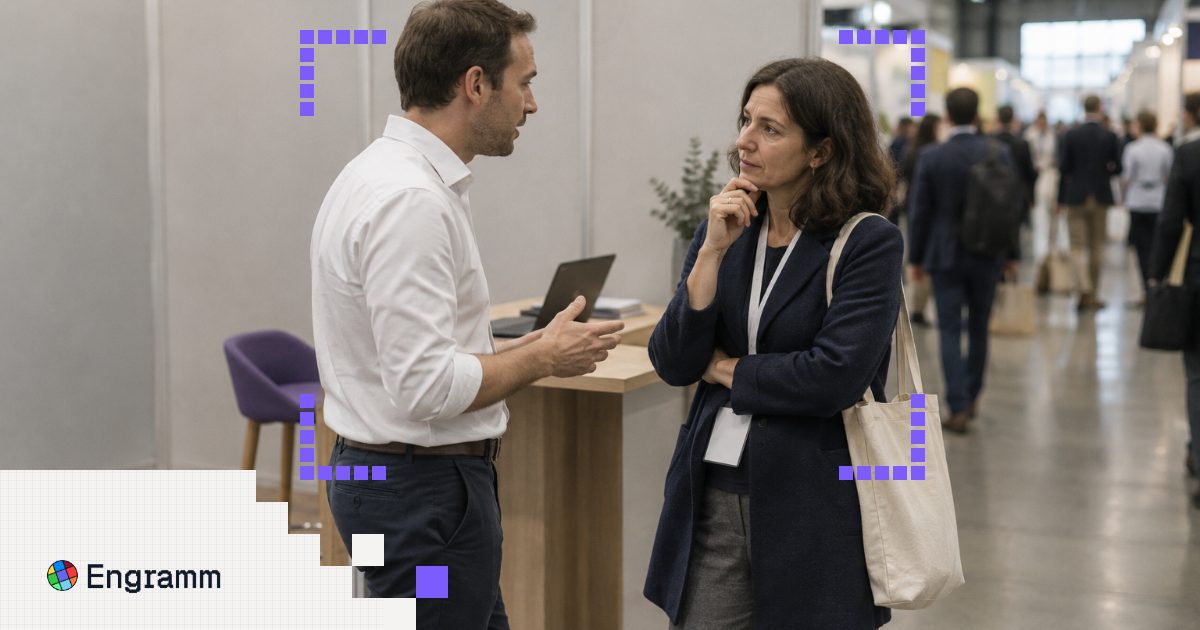
- Laura Bennett, maintenance manager at a 300-person packaging manufacturer, at an industrial trade show. She stops in front of a screen showing predictive maintenance software.
- What she says first
- “I'm just looking at what's new, nothing specific.”
- What she keeps to herself
- Her plant had two unplanned production stops last quarter. The plant manager, who will decide, has asked her for a proposal before June. She saw another supplier that morning.
- What opens her up
- A question about her work or her machines, based on her badge or what she's looking at, then a pitch that starts from her production stops.
- What makes her leave
- A three-minute brochure recital, or the budget question right away. After five minutes, she excuses herself: “I need to meet a colleague.”
The salesperson
- What they know
- The name and company on her badge.
- Their goal
- Find out whether she has a project, by when and who decides, describe the offer in one or two sentences tied to her problem, then book a dated meeting with the plant manager. If there is no project, let her go without holding her up.
- Duration
- Three to five minutes, as at a real booth.
Variants cover the other people who stop at a booth: the visitor in a hurry who wants a brochure, the polite browser with no project, the supplier there to prospect, or the very interested visitor who doesn't decide.
In short
The visitor has a project and a deadline she only shares if the rep asks about her work. The rep has to get both in five minutes and leave with a dated meeting.
The scoring rubric.
| Criterion | What to observe |
|---|---|
| Opening line | A first sentence about the visitor's work or what they're looking at, instead of “Can I help you?” |
| Qualification | The project, the deadline and the decision maker, found through open questions in under five minutes |
| Pitch | One or two sentences about the offer, tied to the problem the visitor mentioned |
| Buying signals | The rep picks up on a deadline, a colleague mentioned or a question about price, and uses it |
| Next step | A dated meeting, or a visitor with no project thanked quickly |
| Recap | The rep sums up what they heard and the agreed next step, and the visitor confirms |
Logged on the contact record, the recap also lets the rep pick up the conversation after the show, where it left off. If the visitor goes quiet, our use case on how to follow up after no response takes over.
Template to download: booth scenario sheet and scorecard
The trainer's sheet, with what the visitor keeps to herself and the other visitor profiles, then the observer's scorecard with six criteria, as a two-page PDF.
In short
The rubric follows the conversation from the opening line to the recap, and checks that the rep gets the project, the deadline and the decision maker before proposing a meeting.
Practicing before the show.
With Engramm's AI roleplays, the team prepares for the show on three to five-minute scenarios, one per visitor profile, built from your offer and the visitors you expect. Reps practice in the days before the event, including on the road. The score covers the criteria in the rubric, and the AI coach suggests opening lines and questions suited to the show. On their dashboard, managers check that everyone working the booth has practiced, new hires included.
In short
A few days before the show, each rep plays the expected visitor profiles, gets a scorecard based on the rubric and works on their opening lines with the AI coach.
Frequently asked questions.
How do you qualify leads at a trade show?
Open with a question about the visitor's work or what they are looking at, then look for three things: whether they have a project, by when, and who decides. Describe your offer in one or two sentences tied to their problem, then propose a dated meeting, or let them go if there is no project.
What questions should you ask at a trade show booth?
“What brings you to the show?”, “How do you handle this today?”, “Do you have a project on this, and for when?”, “Who else will be involved in the decision?”. Keep the budget question for the next meeting.
When should you follow up after a trade show?
In the days after the show, starting with the visitors who have a dated project. Bring up what was said at the booth in your message, so the visitor remembers the conversation.
Sources.
- Timothy M. Smith, Srinath Gopalakrishna and Paul M. Smith (2004), “The complementary effect of trade shows on personal selling,” International Journal of Research in Marketing, 21(1), 61-76: pure.psu.edu