The BANT sales methodology: four qualification criteria and the questions to ask
The BANT sales framework is a way to qualify prospects on four criteria. Before investing time in a deal, the rep checks the prospect's Budget, Authority (who decides), Need and Timeline. Prospects who meet all four criteria get priority, and the others are followed up at a different pace.

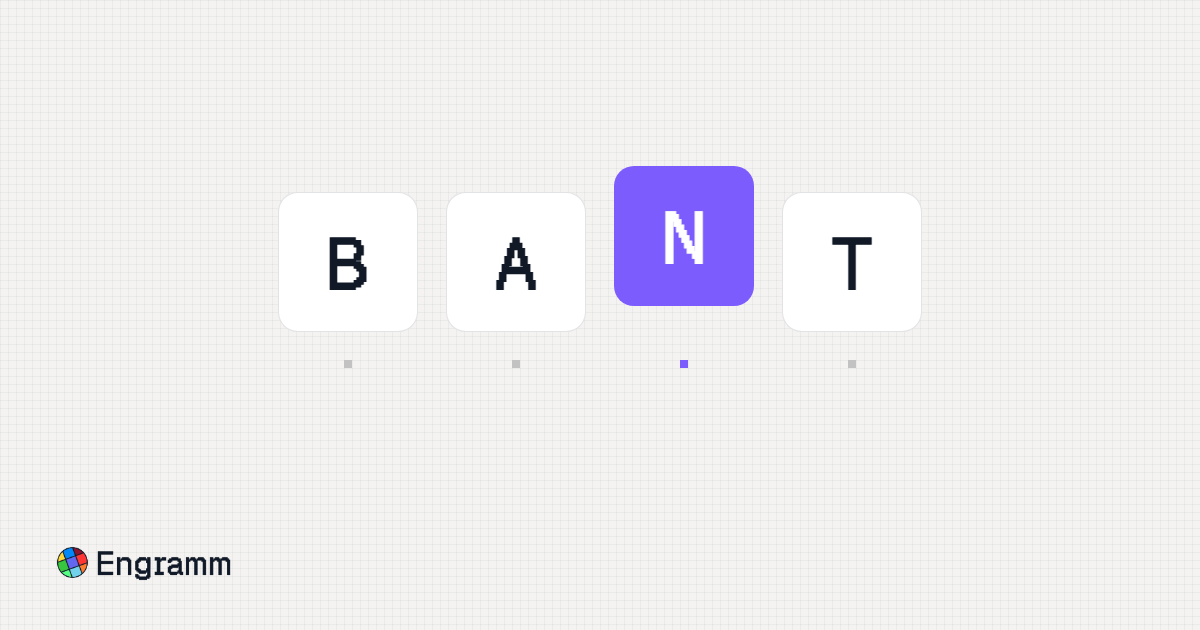
What BANT stands for in sales.
BANT is an acronym made of the framework's four criteria: Budget, Authority (who decides), Need and Timeline. With them, the rep checks whether the prospect can pay, who makes the choice, whether they have a problem the offer solves and when they want to act.
The framework is mostly used on the first call or meeting, by account executives as well as by the SDR teams that qualify leads before handing them over. If a criterion is missing, the deal stays in play, with a next step meant to fill the gap.
In short
BANT checks a prospect's budget, decision-maker, need and timeline. It helps decide, from the first conversation, which deals to prioritize.
Where the BANT framework comes from.
BANT is almost always credited to IBM. HubSpot writes that “a long time ago, IBM revolutionized sales with the introduction of BANT,” but gives no date. Mailchimp traces it back to the 1950s without citing a document. We found no IBM record of how it was created.
BANT does appear in the forms IBM had its business partners fill out in the late 2000s. To register an opportunity to sell IBM software (Software Value Incentive program), a partner had to describe the customer's budget, authority, need and timeframe, the T standing for Timeframe there. Records missing these descriptions “will be rejected as incomplete.”
The forms also show what IBM meant by each criterion. For budget, the partner had to explain how it had been, or would be, identified and approved, so a budget still being built didn't rule a deal out. For authority, they had to name at least one executive on the customer side, and the November 2009 version adds that procurement contacts don't count as decision-makers.
In short
The IBM origin story is repeated everywhere, with no verifiable date. IBM did use BANT in the late 2000s to validate its partners' opportunities.
The four BANT criteria and the questions to ask.
Asked up front and point-blank, BANT questions put the prospect on the defensive, and “What's your budget?” gets nothing more than a cautious number or a dodge. The questions below go after the same information by starting from the customer's situation, here a company looking for a tool to train its sales teams.
Budget
- What you want to know
- Whether money is set aside or could be, roughly how much, who approves it and when in the year.
- Questions to ask
- “How do projects like this usually get funded here?”, “What does the current situation cost you, in time or in training?”, “Who signs off on the spend, and when is next year's budget set?”
- What puts prospects off
- Asking for a number before you've talked about the problem. The prospect has no reason to give one yet.
Authority
- What you want to know
- Who decides, who influences, who signs, and how the company makes this kind of decision.
- Questions to ask
- “Who else will be involved in the choice?”, “How did your last purchase like this one go?”, “What will leadership want to see before they say yes?”
- What puts prospects off
- “Are you the decision-maker?” Your contact will often say yes even if they don't decide alone, and may feel slighted.
Need
- What you want to know
- The problem to solve, what it costs, why it's coming up now and what happens if nothing changes.
- Questions to ask
- “What made you look into this now?”, “How do you handle it today?”, “What happens if nothing changes over the next year?”
- What puts prospects off
- Pitching as soon as the prospect mentions a problem. Discovery stops there, and price comes up before the need is established.
Timeline
- What you want to know
- When the customer wants results, what sets that date and the steps until the decision.
- Questions to ask
- “When do you want this in place, and what's driving that date?”, “What are the steps between now and a decision?”, “What could push the project back?”
- What puts prospects off
- “When are you looking to sign?” The prospect hears the rep's end-of-quarter target in it.
An answer like “We don't have a budget yet” is worth recording, because it tells you the next step, which is to help the customer put a number on the project with the person who will approve the spend.
In short
Each criterion is checked with open questions about the customer's situation. Point-blank questions about budget or the decision-maker, asked too early, get unreliable answers.
The BANT qualification grid.
At the end of the call, the rep notes for each criterion what they learned, what still needs checking and one of three statuses (confirmed, partial or unknown).
| Criterion | What to know by the end of the call | Confirmed when | Dig deeper when |
|---|---|---|---|
| Budget | Amount set aside or rough range, who approves it, when budget decisions are made | The customer names an amount or a budget line, and who signs off on it | “We'll see,” or no idea what the current situation costs |
| Authority | People involved in the choice, each one's role, approval steps | You know the names, the roles and the steps | Your contact is the only name you have |
| Need | The problem, what it costs, why act now | The customer describes the problem in their own words and quantifies its impact | The need stays generic (“we want to modernize how we work”) |
| Timeline | Target date, the event behind it, steps until the decision | A date tied to an event: a launch, a hiring wave, a contract ending | No date, or a date with no reason behind it |
A deal confirmed on need and timeline, with budget still unknown, moves forward with a specific step, such as a meeting with the person who holds the budget. If need isn't established, the deal stays out of the forecast until another qualification call.
Template to download: BANT qualification grid
Questions by criterion, the grid to fill in at the end of the call and the scorecard for the roleplay exercise, as a two-page PDF.
In short
The grid records, criterion by criterion, what's confirmed and what still needs checking. It sets the next step for each deal.
The limits of BANT.
BANT assumes the prospect already has a budget. In complex purchases, the budget is often built during the project, as the customer uncovers a problem, puts a cost on it, then asks for funding. A rep who drops prospects with no budget on the first call misses those projects, or shows up after a competitor has helped the customer build theirs.
The framework also expects a single decision-maker. In B2B, several people take part in the choice, and their average number grew between 2014 and 2016, according to CEB, now part of Gartner.
For the A in BANT, the rep then has to identify each of these people, their role and what they expect, which takes more than one call.
In short
BANT assumes a set budget and a single decision-maker, which is rare in complex purchases.
Start with need.
For these reasons, many teams no longer follow the order of the letters. Prospects talk more readily about budget and decisions once they've described their problem and what it costs them. HubSpot's BANT guide advises starting with the customer's problem and varying the order to fit the conversation.
On a qualification call, that might mean the need and what it costs, then the date that matters to the customer, then the people involved in the decision, and finally the budget, which is then discussed against the cost of the problem. A price given before the need is established has nothing for the customer to measure it against, and they will readily find it too expensive. Our use case on training sales teams on the price objection covers how to prepare a team for it.
In short
Many teams now start with need and leave budget for last. It's then discussed against the cost of the problem.
ANUM, CHAMP and other variants.
ANUM (Authority, Need, Urgency, Money) was put forward in 2013 by InsideSales.com, a software company for sales teams. Its authors believed BANT's principles were still right and only the order needed to change. It puts authority first and money last, and talks about urgency instead of timeline.
CHAMP (Challenges, Authority, Money, Prioritization) starts with the customer's challenges, in other words their need, and replaces the date with the priority they give the project. We couldn't find who created it; Mailchimp lists it among the three main alternatives to BANT, along with ANUM and MEDDIC.
GPCTBA/C&I, HubSpot's qualification framework, starts from the view that BANT is no longer enough now that buyers research on their own before talking to a salesperson. It opens with the customer's goals, plans, challenges and timeline, moves on to budget and authority, then to what the customer risks by doing nothing and gains by acting (Negative Consequences, Positive Implications).
In short
ANUM, CHAMP and GPCTBA/C&I reuse BANT's criteria and move budget after need or authority.
BANT, MEDDIC or SONCAS.
These three methods serve different moments in a sale. MEDDIC was created in 1996 at the software company PTC by Dick Dunkel. SONCAS, widely taught in France and little known in the US, has no known author.
| Method | What it's for | Type of sale | Criteria |
|---|---|---|---|
| BANT | Deciding whether a deal is worth pursuing, and at what pace | First call, short to mid-length cycles, high lead volume | 4: Budget, Authority, Need, Timeline |
| MEDDIC | Managing a complex deal through to signature | Complex B2B sales, several decision-makers, long cycles | 6: Metrics, Economic buyer, Decision criteria, Decision process, Identify pain, Champion (7 in MEDDICC, 8 in MEDDPICC) |
| SONCAS | Spotting buying motives to frame the pitch | Discovery and pitching, in B2B and B2C | 6, from the French: security, pride, novelty, comfort, money, sympathy (7 with SONCASE) |
Within the same sale, a rep can qualify with BANT on the first call, spot what drives the contact during discovery with the six motives of the SONCAS method, then switch to MEDDIC as the deal grows and the buying committee takes shape.
In short
BANT is used to sort deals from the first call. SONCAS helps frame the pitch during discovery, and MEDDIC takes over when the sale gets complex.
Practicing qualification calls in roleplay.
To qualify, a rep has to phrase questions without putting the prospect off and listen for what the answers leave out. They practice this out loud, with someone who keeps part of the information to themselves, for example in this exercise for a pair or a group:
- The trainer writes a prospect sheet: the company, its problem, the state of its budget (set aside, to be built or nonexistent), the people involved in the decision and the date that matters to them. The rep doesn't see it.
- The rep runs a 15-minute call. They need to come out of it with the four pieces of information and a next step with a date.
- The prospect answers open questions willingly, stays evasive if asked right away about budget or whether they decide alone, and only mentions the other decision-makers if asked how the company makes its choices.
- The rep fills in the qualification grid, which is then compared with the prospect sheet.
- Start again with a prospect who has no budget set aside, then with a project decided by committee.
| Criterion | What you observe |
|---|---|
| Question order | Was need explored before budget? |
| Open questions | Number of open questions asked during the call |
| Decision | Does the rep know the other people involved in the choice and their roles? |
| Timeline | Did they get a date and the event behind it? |
| Next step | A dated step the prospect agreed to |
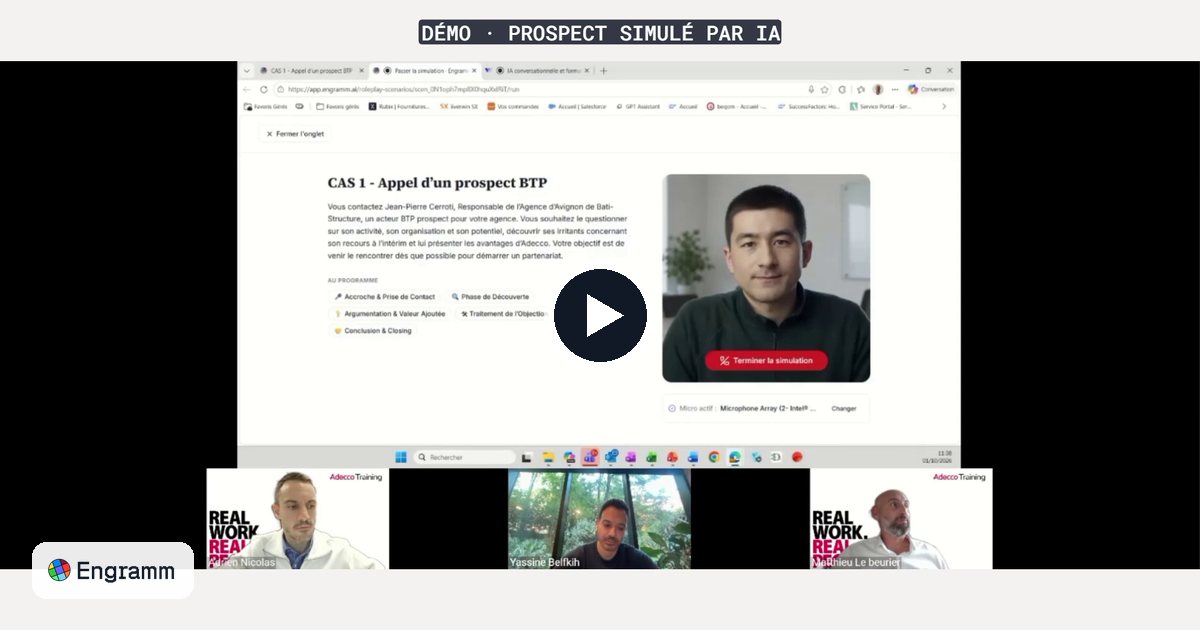
With a trainer or a colleague playing the prospect, each round takes at least two people, which limits how many calls each rep can run. In Engramm's voice roleplays, the scenario describes the prospect and the information the rep has to uncover during the call. The character answers in under 500 ms and adjusts their attitude to how the call is handled. Variants of the same scenario change the profile, from a curious buyer who lets you talk to a busy executive who interrupts, and every call is scored on your criteria.
For industrial sales, where decisions go through a committee, see also our page on complex sales training in industry.
In short
The exercise is done out loud with a scorecard, against prospects with different profiles who don't reveal everything.
Frequently asked questions.
What does BANT mean in sales?
BANT stands for Budget, Authority, Need and Timeline: the prospect's budget, their power to decide, their need and their buying timeline. It's a qualification framework used to decide, from the first conversation, whether a deal is worth pursuing and at what pace.
What is the difference between MEDDIC and BANT?
BANT checks four criteria to sort deals on the first call. MEDDIC, created at PTC in 1996, tracks six (Metrics, Economic buyer, Decision criteria, Decision process, Identify pain, Champion) to manage a complex sale through to signature. You can use BANT on the first call, then MEDDIC for deals that move forward.
What are good BANT questions?
Open questions about the customer's situation, starting with need: “What made you look into this now?”, then “What's driving your date?”, “Who else will be involved in the choice?” and “How do projects like this usually get funded here?”
Sources.
- IBM, “Budget Authority Need Timeframe (BANT) Criteria Template,” v3.4, November 2008: public.dhe.ibm.com
- IBM, “Budget Authority Need Timeframe (BANT) Criteria Form,” Software Value Incentive program, v5.0, November 2009: public.dhe.ibm.com
- Pablo Londoño, “BANT Isn't Enough Anymore: A New Framework for Qualifying Prospects,” HubSpot, updated May 2, 2025: blog.hubspot.com
- Shannon L. Jackson, “How I use BANT to qualify prospects [+ expert tips],” HubSpot, 2019, updated July 31, 2025: blog.hubspot.com
- Mailchimp, “What Is BANT?”: mailchimp.com
- InsideSales, “A Reflection on ANUM: Qualifying Leads,” February 6, 2013: insidesales.com
- MEDDICC, “What is MEDDIC / MEDDICC / MEDDPICC?”: meddicc.com
- CEB, “Leading B2B Sales Organizations Challenge, Align & Prescribe To Get Deals Done,” press release, November 21, 2016: prnewswire.com