MEDDPICC: what it stands for, the questions to ask and how to practice them
MEDDPICC is a qualification framework for complex B2B sales. Its eight criteria tell you what you need to know about a deal to judge whether it can close, building on MEDDIC, which had six.

What MEDDPICC stands for.
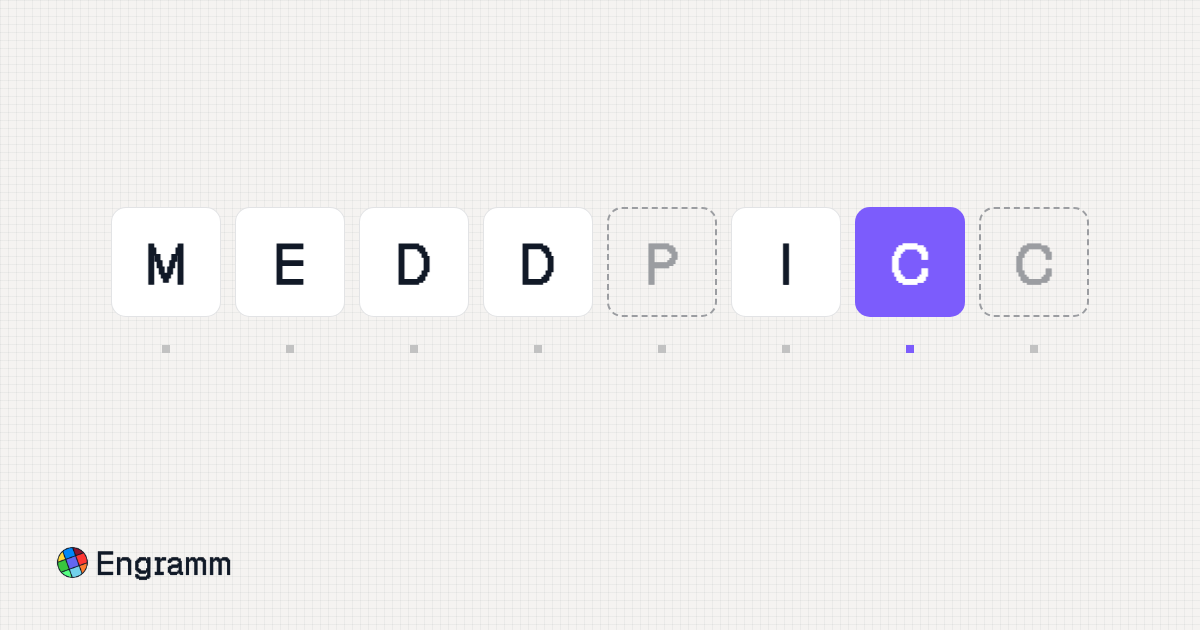
MEDDPICC is an acronym in which each letter names a piece of information you need about the deal: the measurable gains the customer expects (Metrics), the person who decides on the spend (Economic buyer), the criteria they'll use to compare offers (Decision criteria), the steps and people in their decision (Decision process), the administrative path to signature (Paper process), the problem behind the project (Identify pain), the person who argues for your offer internally (Champion), and everything that could take your place, including doing nothing (Competition).
The original version, MEDDIC, has six letters, without Paper process and the second C.
Teams use it as a checklist across the whole deal. After each meeting, the rep and their manager separate what the customer has confirmed from what is still assumed. It also feeds the forecast, since a deal whose economic buyer hasn't been met and whose paper process is unknown has no reliable close date.
In short
MEDDPICC lists eight things to find out about a deal, six in the original MEDDIC. After each meeting, you check which ones the customer has confirmed.
Where the framework comes from.
MEDDIC was born in the mid-1990s at PTC, an American software company. According to the account published by MEDDICC, PTC's sales team had grown to about 300 people and rep attrition had become a serious problem. Dick Dunkel and Jack Napoli, who worked under their SVP, John McMahon, went through the team's deals to understand why they were won, lost or pushed back. The answers came down to six elements, whose initials became the acronym. MEDDICC dates this work to 1996.
Darius Lahoutifard, who founded MEDDIC Academy, has collected other testimony on how the framework started and reports two versions. According to Dunkel and Napoli, the six elements were pinned down on a whiteboard during a meeting; John McMahon describes something built gradually, from the practices of field teams.
A second C, for Competition, came later and gave MEDDICC, then the P for Paper process gave MEDDPICC. None of these sources says who introduced them or when.
In short
MEDDIC comes from the software company PTC in the mid-1990s, with Dick Dunkel, Jack Napoli and John McMahon. Accounts differ on how it was designed.
The eight MEDDPICC criteria and the questions to ask.
The examples follow a software vendor selling a maintenance management system to a manufacturing group. The two criteria MEDDPICC added to MEDDIC have a dashed letter.
Metrics
- What you want to know
- The results the customer expects, quantified with their own data, such as downtime hours avoided or lower maintenance costs. The economic buyer will rely on these numbers to approve the spend.
- Questions to ask
- “How do you measure this problem today?”
“What does an hour of line downtime cost you?”
“A year from now, what result will tell you the project worked?”
Economic buyer
- What you want to know
- The person who can commit the budget, or refuse it even if everyone else is in favor. You need their name and what they expect from the project, including what worries them. It isn't always the most senior person on the committee.
- Questions to ask
- “Who will sign off on the budget for this project?”
“On a similar project, who made the final call?”
Decision criteria
- What you want to know
- The criteria the customer will use to compare offers, from price to technical requirements, and how much each one weighs. Ideally you learn them before the RFP is written, while they can still change.
- Questions to ask
- “What criteria will you use to compare solutions?”
“Which one comes first?”
“What would rule out an offer right away?”
Decision process
- What you want to know
- The steps in the decision (trial, committee, sign-off by leadership), who's involved at each one, and the dates. The date should come from the customer and rest on an event, such as the end of the current maintenance contract.
- Questions to ask
- “How does the decision work, from trial to final choice?”
“Who's involved at each step?”
“What sets the date you want to decide by?”
Paper process
- What you want to know
- What happens between the decision and the signature: vendor onboarding, legal review, security review, purchase order. These steps can take weeks and push back a deal you've already won.
- Questions to ask
- “Once you've chosen a solution, what steps are left before signature?”
“Do you need to onboard a new vendor, and how long does that take?”
“Who signs the contract?”
Identify pain
- What you want to know
- The problem behind the project, for example unplanned line stoppages, its consequences for the company and for the people dealing with it, and what happens if nothing changes.
- Questions to ask
- “What made you look at this now?”
“What happens if you do nothing this year?”
Champion
- What you want to know
- Someone with influence and a personal stake in the project's success, who argues for your offer when you're not in the room. You recognize them by what they do for the deal, such as passing on internal information or getting you a meeting.
- Questions to ask
- “What would this project's success change for you?”
“How would you present our proposal to your leadership?”
“Could you set up a conversation with the person who'll approve the budget?”
Competition
- What you want to know
- Everything that could take your offer's place: other vendors, an in-house build, another project competing for the same budget, or the decision to do nothing.
- Questions to ask
- “What other solutions are you looking at?”
“What other projects are waiting on the same budget?”
In short
A criterion is checked with open questions and only counts once the customer has confirmed it.
Where qualification goes wrong.
A friendly contact who replies fast and speaks well of your offer easily passes for a champion. They may still be willing to buy without being willing to stand up for the supplier in front of colleagues, like one customer in two according to CEB (now part of Gartner). To find out, ask for an action, such as a meeting with the economic buyer, and see what they do with it.
Sometimes the economic buyer is known by name but never met. The champion offers to “handle it,” and the deal moves forward without the person who signs ever hearing the expected gains. The champion is only one of the people who weigh on the decision; CEB counted an average of 6.8 in a B2B purchase in 2016, up from 5.4 in 2014, each with their own priorities.
Reps also often leave doing nothing off their list of competitors. For their book The JOLT Effect, Matthew Dixon and Ted McKenna analyzed about 2.5 million recorded sales conversations. According to Dixon, between 40 and 60% of deals are lost because the customer does nothing. Most of those losses come from fear of making a mistake, the others from customers happy with the status quo. On every deal, ask the customer, “What happens for you if this project gets pushed back a year?”
In short
The usual mistakes are trusting a champion who hasn't done anything yet, never meeting the economic buyer, and forgetting the option of doing nothing.
MEDDIC vs. MEDDICC vs. MEDDPICC.
The three names refer to the same framework, with six, seven or eight criteria.
| Version | Criteria | What's added |
|---|---|---|
| MEDDIC | 6 | The original: Metrics, Economic buyer, Decision criteria, Decision process, Identify pain, Champion |
| MEDDICC | 7 | Competition: other vendors, in-house projects, doing nothing |
| MEDDPICC | 8 | Paper process: the administrative steps between decision and signature |
The P becomes useful as soon as procurement, legal or IT security step in after the decision, which often happens with enterprise accounts. When the signature doesn't go through any of these departments, you can stick to MEDDIC's six criteria.
The I is sometimes written Implicate the pain, in which case MEDDICC asks reps to identify the problem, then tie it to its consequences for the customer. MEDPICC, with a single D, is a common misspelling of MEDDPICC.
In short
MEDDICC adds Competition to MEDDIC's six criteria, and MEDDPICC also adds the paper process.
MEDDPICC or a lighter framework, depending on the deal.
MEDDPICC is built for deals where several people decide over several months, and where the amount justifies a committee and a competitive evaluation. That's the case for enterprise software and for industrial sales, where engineering, procurement and executive leadership decide together.
With a single decision-maker and a short cycle, eight criteria weigh down preparation, and a lighter framework fits better.
| Framework | What it checks | When to use it |
|---|---|---|
| BANT | Budget, authority, need, timeline | First call, screening inbound leads |
| BEBEDC | Need, environment, budget, timing, decision-makers, competition (a French checklist) | Discovery in a mid-sized B2B sale |
| MEDDIC, MEDDPICC | The six or eight criteria described above | Complex sales, several decision-makers, long cycle |
| SONCAS | Each person's buying motives (a French method) | Building arguments, alongside a qualification framework |
A team can combine the two, with BANT on the first call to screen leads and MEDDPICC once the deal is in play. For building arguments, our guide to the SONCAS method and buying motives shows how to spot, during discovery, what drives each committee member.
In short
MEDDPICC fits deals with several decision-makers and long cycles. BANT or BEBEDC cover first-call screening and simple sales, and SONCAS helps build arguments.
A MEDDPICC qualification scorecard.
After every meeting, note for each criterion what you know and where it came from, then score it from 0 to 2: 0 if unknown, 1 if assumed, 2 if confirmed by the customer.
| Criterion | Confirmed when… | Red flag |
|---|---|---|
| Metrics | The customer has quantified the gains with their own data and owns them | The numbers only appear in your proposal |
| Economic buyer | You've met them and they've validated the expected gains | “I'll take care of it,” with no meeting scheduled |
| Decision criteria | The criteria are known and ranked, and your offer meets the top ones | An RFP shows up fully written, with no prior conversation |
| Decision process | Steps, people and dates are known, with a reason to decide by that date | No date, or a date with no reason |
| Paper process | The path to signature is known, with its timelines and the signer | “Procurement will deal with that at the end” |
| Identify pain | The problem has a quantified consequence and a deadline | The topic is “interesting,” with no urgency |
| Champion | They've acted on the deal: meeting secured, internal information shared | Enthusiastic, but hasn't done anything |
| Competition | You know the other options, including doing nothing | “You're the only ones we're talking to” |
Check for zeros before adding up the total, since a single unknown criterion can make the close date uncertain. In a deal review with the manager, every 2 should be backed by something the customer said or did.
Template to download: MEDDPICC qualification scorecard
The scorecard to fill in after each meeting, the questions by criterion and the roleplay exercise sheet, as a two-page PDF.
In short
Score each criterion from 0 to 2 depending on whether it's unknown, assumed or confirmed by the customer, and deal with the zeros first.
Practicing MEDDPICC in a roleplay.
In a meeting, the rep has to ask these questions without turning the conversation into an interrogation, test the champion without putting them off, then hold their own for ten minutes with a busy economic buyer. The exercise works in pairs or in a group and has two meetings.
- The trainer prepares an account sheet: the company, the project, and for each criterion what the champion knows and what the economic buyer knows. For example, the champion knows the problem and the decision criteria, but neither the budget nor the paper process. The economic buyer is torn between this project and another one.
- First meeting, fifteen minutes, with the champion. The rep tries to fill in the scorecard and to get a meeting with the economic buyer. The champion answers willingly, but only sets up that meeting if the rep gives them a reason to.
- The rep scores each criterion from 0 to 2 and prepares the second meeting by listing what needs confirming, and by whom.
- Second meeting, ten minutes, with the economic buyer. They talk about results and risks, ask about price and bring up the other project. The rep needs to get the metrics, the timeline and the paper process validated.
- The observer compares the rep's scorecard with the account sheet. Then run it again with a different champion profile, an enthusiast with no influence or a skeptical expert.
| Criterion | What you observe |
|---|---|
| Champion tested | An action requested, such as a meeting with the economic buyer |
| Metrics | Numbers from the customer, validated by the economic buyer |
| Decision and signature | Steps, people, dates and timelines obtained |
| Competition | A question about what happens if the customer does nothing |
| Scorecard | Gap between the rep's scores and the account sheet |
If the economic buyer pushes back on price, our use case on the “it's too expensive” objection shows how to find the cause before answering.
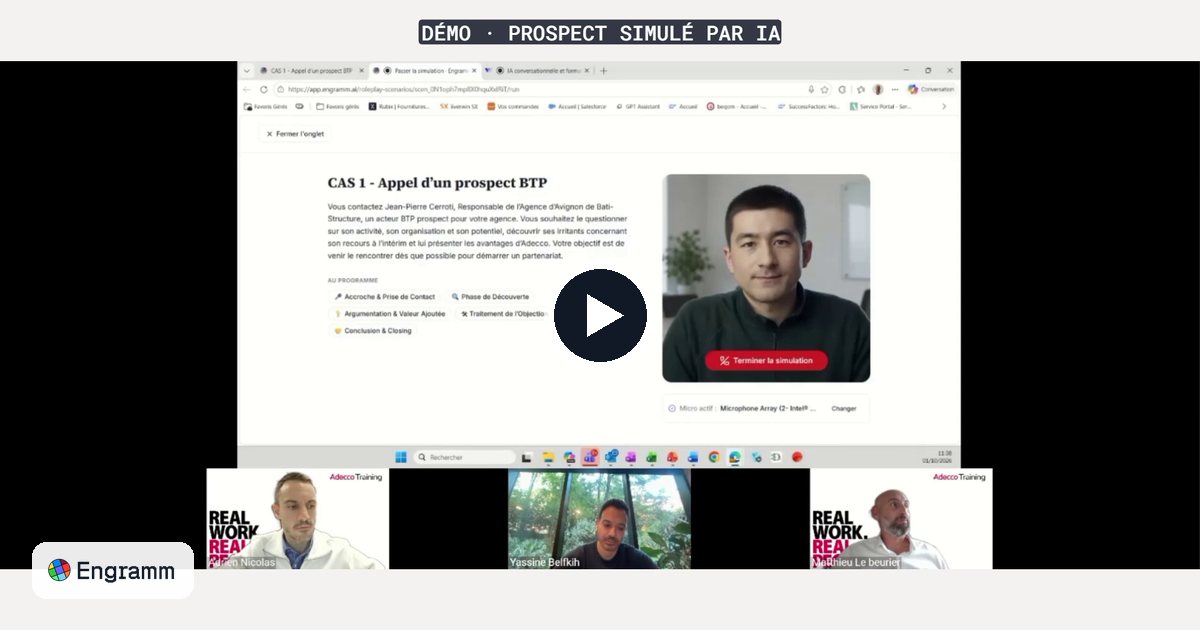
In a classroom, each run ties up two colleagues to play the champion and the economic buyer. In an Engramm AI roleplay, the two meetings become two scenarios on the same account, each with its character and the information the rep has to get out of them, such as the budget or the paper process. The character opens up or closes down depending on the questions they hear. The scorecard follows your criteria, for example one per letter of MEDDPICC, and the AI coach then goes back over what the rep didn't get. Variants change the champion's profile or how demanding the economic buyer is.
In short
MEDDPICC is practiced over two meetings, with the champion and then the economic buyer, from an account sheet that splits the information between them.
Frequently asked questions.
What is the MEDDIC sales qualification framework?
MEDDIC is a qualification framework for complex B2B sales, born at the software company PTC in the mid-1990s. Its six criteria (Metrics, Economic buyer, Decision criteria, Decision process, Identify pain, Champion) tell you what you need to know about a deal to judge whether it can close.
What does MEDDPICC stand for?
MEDDPICC stands for Metrics, Economic buyer, Decision criteria, Decision process, Paper process, Identify pain, Champion and Competition. Metrics are the measurable gains the customer expects, the economic buyer decides on the spend, the paper process covers the administrative steps up to signature, the champion argues for your offer internally, and competition includes other vendors, in-house projects and doing nothing.
What's the difference between MEDDIC and MEDDPICC?
MEDDPICC keeps MEDDIC's six criteria and adds two: Paper process, the administrative steps between the decision and the signature, and Competition, which includes the option of doing nothing. MEDDICC only adds Competition.
Sources.
- MEDDICC, “Who Created MEDDIC? The History Behind the Framework”, October 15, 2026: meddicc.com
- MEDDICC, “MEDDPICC Sales Methodology: Acronym & Meaning”: meddicc.com
- Darius Lahoutifard, “History of MEDDIC and MEDDPICC: A Documented Chronicle”, October 2026: meddpicc.net
- CEB, “Leading B2B Sales Organizations Challenge, Align & Prescribe To Get Deals Done”, press release, November 21, 2016: prnewswire.com
- Adrian Swinscoe, “The problem of customer indecision and how to get over it – Interview with Matt Dixon”, CustomerThink, October 12, 2022: customerthink.com
- Matthew Dixon and Ted McKenna, The JOLT Effect: How High Performers Overcome Customer Indecision, Portfolio, 2022, publisher's description: penguinrandomhouse.com