The CROC method: how to structure a prospecting call in four steps
The CROC method is a four-step plan for outbound phone calls: Contact, Reason, Objective, Conclusion. Sales reps use it to prepare and run a prospecting call, most often to book a meeting. It comes from French sales training, where it is taught alongside CERC, its counterpart for inbound calls.

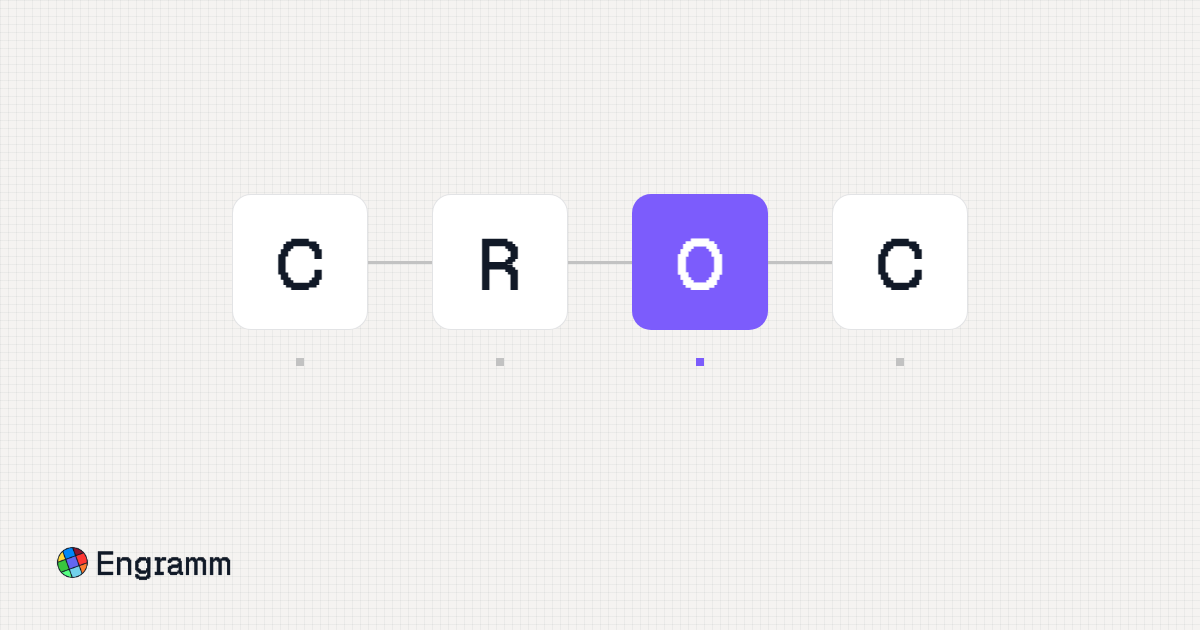
What the CROC method stands for.
CROC is an acronym for the four steps of an outbound call. At the Contact step, the rep greets the person, introduces themselves and their company, and checks they're speaking to the right person. They then give the Reason for the call and state the Objective, meaning what they're calling to ask for. The Conclusion sums up what was agreed before saying goodbye.
The method appears in French vocational textbooks. The one published by Éditions Foucher tells salespeople to prepare every outbound call with a call sheet and the documents they'll need, then to follow the CROC plan. In French search results, most pages present it as a framework for cold calling, meant to book a meeting or take an order. Our examples follow that use.
Sources don't fully agree on the R. Most read it as Raison, the reason for the call; some write Rassurer, “reassure,” in the sense of showing the person that the call is worth their time. Either way, the rep has to say briefly why they're calling and what the prospect stands to gain. We found neither the author of the method nor the date it first appeared.
In short
CROC breaks an outbound call into four steps: Contact, Reason, Objective, Conclusion. Taught in France for all outbound calls, it's mostly used for cold calling.
The four steps of the CROC method, with examples.
The examples follow a single call. Tom, a rep at a commercial kitchen maintenance company, calls the director of operations of a twelve-restaurant group that has just announced two new locations in Austin.
Contact
- What the rep does
- Gives their name and company, checks they have the right person and asks whether it's a good time. The step takes a few seconds.
- Sample line
- “Hi, this is Tom Garner with Calder Maintenance. Am I speaking with Ms. Lopez, director of operations? Do you have two minutes, or should I call back later today?”
- Avoid
- “Is this a bad time?”, which is easy to answer with a yes, and describing the company before the prospect knows why you're calling.
Reason
- What the rep does
- Explains in one or two sentences why they're calling this person now, based on something that concerns them, such as a new location or a previous conversation.
- Sample line
- “I read that you're opening two restaurants in Austin this spring. We maintain the kitchens of about ten restaurants in town, and the maintenance contract is usually decided before opening day.”
- Avoid
- “I'm calling to tell you about our company.” The sentence is about the rep and gives the prospect no reason to stay on the line.
Objective
- What the rep does
- Makes a single request, prepared before the call and specific enough to get a yes or a no: a meeting, a site visit, a trial, the name of the right person.
- Sample line
- “I'd like to spend half an hour at the first site to look at the equipment you're planning. Would Tuesday the 14th or Thursday the 16th work better for you?”
- Avoid
- Asking for two things at once, or ending on “I'll send you a brochure,” which asks nothing of the prospect.
Conclusion
- What the rep does
- Repeats what was agreed (date, place, attendees), says what they'll send, thanks the prospect and hangs up. Once the prospect has said yes, the rep doesn't reopen the discussion.
- Sample line
- “So that's Thursday the 16th at 10 a.m., on site, with you and your executive chef. I'll send the invite this afternoon. Thanks, Ms. Lopez, have a good day.”
- Avoid
- Hanging up on “let's touch base” with no date, or pitching again after the yes.
Template to download: CROC call sheet and scorecard
The call sheet to prepare step by step, with the fallback request and your answers to expected objections, and the scorecard for the roleplay exercise, as a two-page PDF.
In short
The contact takes a few seconds, the reason starts from the prospect's situation, the objective is one specific request and the conclusion repeats what was agreed.
Objections between the reason and the objective.
The method goes straight from the reason to the objective. On a cold call, though, the prospect reacts to the reason before hearing the request, and the first reaction is often an objection. If the rep moves on to the request without answering, the prospect hangs up. A long pitch doesn't help either, since the call turns into a presentation. It works better to acknowledge the objection, ask a question, then come back to the request.
| Objection | What it may mean | Possible answer |
|---|---|---|
| “I don't have time.” | Bad timing, or the reason didn't land | “Understood. Should I call back Thursday morning, or can I tell you in one sentence why I'm calling?” |
| “We already have a provider.” | The need is covered, or nobody has compared in a while | “Does their contract also cover the two new locations?” |
| “Send me some information.” | A polite way to end the call, or real interest | “Happy to. So I send what's relevant, what equipment are you planning for the kitchens?” |
| “How much is it?” | Concern about cost, or a way to test the rep | “It depends on the equipment and how often we visit, which is what I'd like to look at with you on site.” |
Each answer in the table ends with a question that steers the conversation back to the request. Our guide to objection handling covers the five-step method and the most common B2B objections.
The reason sentence also depends on what matters to the prospect. A director of operations worried about a breakdown on opening day won't respond to the same sentence as one whose first concern is cost, and the SONCAS method helps spot these buying motives. The FAB method then helps put what the prospect gains into words.
In short
CROC has no step for objections. The rep acknowledges the objection, asks a question and comes back to the request.
Setting the objective of the call.
In the 1970s, Neil Rackham and the Huthwaite researchers observed thousands of sales calls to understand what sets successful salespeople apart. They sorted the outcome of each call into one of four categories, and only two counted as successes, the ones where the customer makes a new commitment.
| Outcome | What happens | At the end of a cold call |
|---|---|---|
| Order (success) | The customer buys | The prospect orders during the call |
| Advance (success) | The customer commits to a step that moves the decision forward | A scheduled meeting, a site visit, a trial, an introduction to the decision-maker |
| Continuation (failure) | The conversation goes on with no commitment from the customer | “Call me back in three months,” “Send me something” |
| No sale (failure) | The customer says no | The prospect declines any next step |
For a cold call, the objective is therefore an advance. The rep also prepares a fallback objective, smaller but still concrete, such as the name of the person who handles maintenance contracts, or a callback tied to a date that matters to the prospect, for example the lease signing for the new restaurant. Going for the order rather than an advance is a matter of closing a sale.
In short
The objective of a CROC call is a concrete commitment from the prospect, such as a scheduled meeting. A fallback objective, prepared before the call, is there in case the prospect says no.
CROC or CERC.
The Foucher textbook, like other course material, pairs CROC with CERC, the plan for inbound calls: Contact, Écoute (listening), Réponse (response), Conclusion. On an inbound call, the caller is the one with a reason to call. The agent listens, rephrases, then answers the request or passes it on.
| CROC | CERC | |
|---|---|---|
| Type of call | Outbound: cold calling, booking meetings, follow-up | Inbound: information requests, complaints, orders |
| Who leads | The rep, who has prepared a request | The caller, who explains theirs |
| Steps | Contact, Reason, Objective, Conclusion | Contact, Listening, Response, Conclusion |
| End of the call | A commitment from the prospect on the prepared request | An answer to the request, or an agreed callback |
Contact center agents, who mostly take inbound calls, work closer to CERC. Our guide to call center agent training describes these calls and the quality scorecard used to assess them. The same agent switches to a CROC plan when calling a customer back to offer something.
In short
CROC is for calls you make, CERC for calls you receive. In the first case, the rep is the one with a reason to call.
When to use the CROC method.
CROC suits short calls built around a single request: booking a meeting on a cold call, following up on a quote that got no answer, or a bank advisor calling a client to suggest a review of their savings. For a follow-up, the reason is the previous conversation and the objective is a decision or a date.
If the prospect is willing to talk, a few qualifying questions fit between the reason and the objective. The criteria of BANT sales qualification (need, timeline, who decides and budget) tell you which ones to ask, and the answers help you choose between the planned request and the fallback.
For a full script, getting past the gatekeeper and the best times to call, see our guide to cold calling scripts. A discovery meeting, which takes more questions and more time, calls for a discovery plan.
In short
CROC is for short calls built around a single request: booking a meeting, following up, making an offer to a customer. It works alongside a qualification framework such as BANT.
Common mistakes.
A CROC plan read like a script is obvious from the second sentence, and a rep following a text stops listening to the answers. The plan works better as a short call sheet with the reason sentence, the request, the fallback request and two or three answers to the expected objections.
The same reason sentence sent to every prospect on a list rests on nothing that concerns them, and the prospect quickly realizes it's a mass call. An event worth mentioning can be found in a few minutes on the company's website or in the local press.
Without a fallback request, a rep who hears a no ends the call on an undated “I'll call you back.” Pushing after a clear no, on the other hand, hurts the next calls. And a call with nothing logged in the CRM leaves the colleague who calls next starting from scratch.
In short
The common mistakes are reading the plan word for word, sending the same reason to every prospect, having no fallback request, pushing after a no and logging nothing about the call.
Practicing the CROC method in roleplay.
The following exercise puts the rep in front of a prospect who interrupts or answers the reason with an objection. It works in pairs or small groups, with the two players back to back so they can't see each other, as on the phone:
- The trainer writes three prospect sheets with the industry, job title, the event that justifies the call, the objection the prospect will raise and what would make them agree to a meeting. The rep only gets the name, title and event.
- The rep prepares a call sheet in five minutes: the reason sentence, the request and the fallback request.
- The rep makes a call of three minutes at most. The prospect raises the objection after the reason and only agrees to a meeting if the reason concerns them and the request is specific.
- An observer fills in the scorecard below, then the group compares the rep's call sheet with the prospect sheet.
- Run the call again with a busy prospect who interrupts, then with one who asks for the price right after the reason.
| Step | What you observe |
|---|---|
| Contact | Name, company and check of the person, in a few seconds |
| Reason | One or two sentences that start from the prospect's situation |
| Objection | The rep acknowledged the objection and asked a question before coming back to the request |
| Objective | A single, specific request, with a proposed date |
| Conclusion | Recap of what was agreed, without reopening the discussion |
| Listening | The rep picked up a word or fact the prospect mentioned |
In a classroom, each rep makes one or two calls during the session while the others listen. In Engramm's AI call roleplays, the scenario is built from your call plan and product sheets: the type of call (cold or with an existing customer), the prospect, what they know and the objection they'll raise. The rep makes the call alone, by voice, and the prospect reacts to what they hear. Variants change the profile, from an available manager to a busy executive who interrupts. The scorecard can have one line per CROC step, and the AI coach then goes over the reason sentence and the request with the rep.
In short
The method is practiced out loud, with prospects who raise objections and a scorecard that grades each step.
Frequently asked questions.
What is the CROC method in sales?
The CROC method is a four-step plan for outbound phone calls: Contact, Reason, Objective, Conclusion. In sales, it's mostly used for cold calling, to book a meeting, and for follow-up calls. The rep prepares the reason for calling and the request before dialing.
What is the difference between the CROC and CERC methods?
CROC (Contact, Reason, Objective, Conclusion) structures the calls you make, with the rep leading toward a prepared request. CERC (Contact, Listening, Response, Conclusion) structures the calls you receive: the agent listens to the caller's request, rephrases it and answers it.
What is an example of a CROC call?
A kitchen maintenance rep calls the director of operations of a restaurant group. He introduces himself (Contact), mentions that the group is opening two restaurants and that the maintenance contract is decided before opening (Reason), suggests half an hour on site on Tuesday or Thursday (Objective), then repeats the date they agreed on (Conclusion).
What is the most effective cold calling method?
We found no published study comparing cold calling methods with one another. CROC gives a simple plan for a short call. It works alongside a qualification framework such as BANT and prepared answers to objections, and it's practiced out loud, by repeating calls with feedback on each step.
Sources.
- Éditions Foucher, summary sheet “Le téléphone et le live chat” (unit 19), CROC and CERC methods, in French: foucherconnect.fr
- Yann Guilleux, “Méthode croc : quand et comment l'utiliser pour réussir ses appels ?”, HubSpot, updated January 13, 2025, in French: blog.hubspot.fr
- Bitoubi, “Méthode CROC : comment l'utiliser pour sa prospection téléphonique ?”, October 1, 2024 (“Rassurer” variant), in French: bitoubi.net
- Huthwaite International, “The science behind SPIN Selling,” white paper (outcomes of a sales call): huthwaiteinternational.com