The FAB method in sales: turning features into customer benefits
The FAB method builds a sales argument in three parts: a Feature of the offer, the Advantage it provides, then the Benefit for the specific customer you're talking to. The benefit restates a need that customer expressed during discovery. French sales training calls the same method CAB, and a close variant, CAP, replaces the benefit with proof.

What the FAB method means in selling.
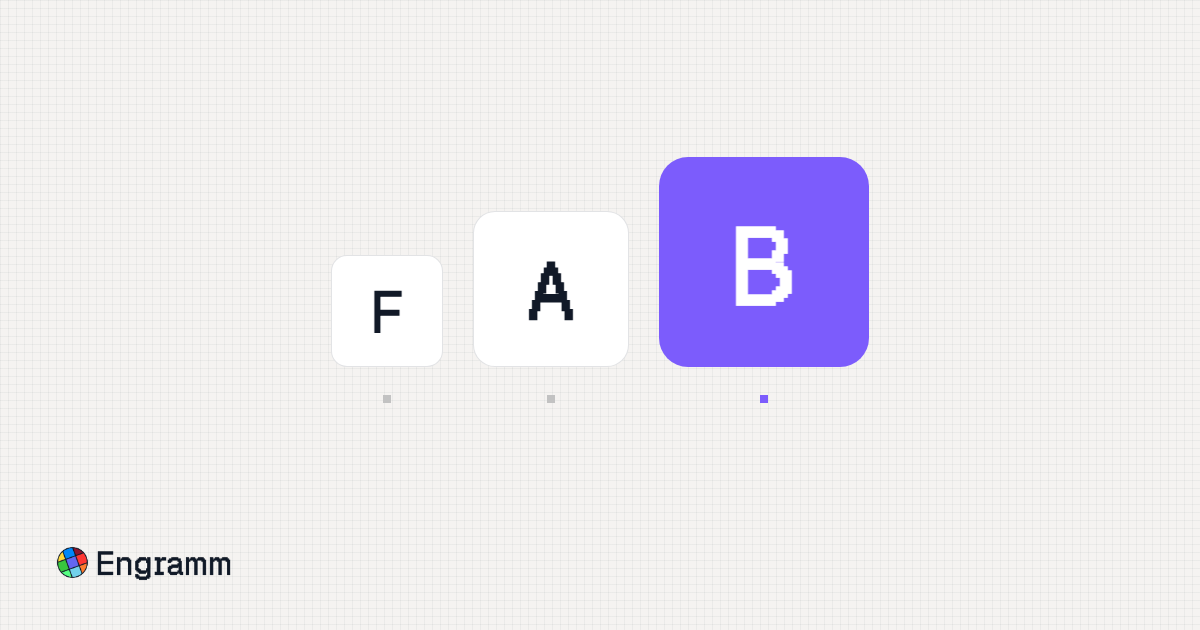
FAB stands for Features, Advantages, Benefits. A feature is a fact about the offer, verifiable and the same for every customer, such as a function, a size, a warranty or a delivery time. An advantage says what that feature makes possible, for any customer. A benefit says what it changes for the customer you're talking to, given their situation.
The difference between an advantage and a benefit is therefore personalization, as Pipedrive's French-language guide to the method puts it. The same advantage leads to different benefits from one customer to the next, and a rep can only phrase a benefit after learning something about the customer.
We found no author for the method. Neil Rackham, whose firm Huthwaite observed thousands of sales calls from the 1970s on, defines the benefit more strictly: it shows how the offer meets an explicit need, meaning a want the customer has stated themselves.
In short
The FAB method chains a fact about the offer, what it does in general and what it changes for a specific customer. Only the benefit is specific to that customer.
Features, advantages and benefits, with B2B and B2C examples.
In the first example, a rep offers a forklift with a lithium-ion battery to the manager of a warehouse that runs two shifts. In the second, a salesperson in a bike shop helps a customer who wants to commute to work choose an e-bike.
| Level | B2B: forklift | B2C: e-bike |
|---|---|---|
| Feature | Lithium-ion battery that charges in short bursts during breaks | Mid-drive motor, removable high-capacity battery |
| Advantage | No battery swaps during the day, no dedicated charging room | Several rides between charges, and a battery you can charge at the office or at home |
| Benefit for this customer | “Your operators no longer lose the twenty minutes per battery swap you described at every shift change, and your charging room goes back to being storage space.” | “You'll ride your nine miles to the office, hill included, without arriving sweaty, and you can charge the battery under your desk.” |
Features and advantages are prepared before the meeting, from the product sheet. The benefit is phrased with what the customer said, the twenty minutes lost at each shift change or the hill before the office, and a rep who asked no questions only has the first two rows of the table to work with.
In short
Features and advantages come from the product sheet. The benefit is phrased during the conversation, with what the customer said about their situation.
How to turn a feature into a benefit for a specific customer.
The rep builds the argument in the reverse order of the acronym. They start from what the customer said during discovery, which our guide to discovery questions covers in detail, then pick the features that answer it before phrasing the benefit:
- During discovery, note the problems the customer describes, in their words and with their numbers, for example “we lose twenty minutes at every shift change.”
- Check that the customer wants to solve them. Neil Rackham distinguishes implied needs, a difficulty the customer describes (“battery swaps slow us down”), from explicit needs, a stated want for a solution (“we need forklifts that last both shifts”). According to Huthwaite, in major sales only explicit needs are linked to a successful call. A question like “What would it mean for you to get rid of those swaps?” helps the customer move from one to the other.
- Pick the two or three features from the product sheet that answer those needs, and leave the rest aside.
- Phrase the benefit in the customer's words, linking the feature to the situation they described. A bridge such as “which means for you that” connects the advantage to the benefit.
- Check with a question that the argument answers what the customer expects, for example “Would that solve the shift-change problem?” French textbooks call this “locking in” the argument with a check question.
Neil Rackham built a questioning method from his observations that leads customers to state explicit needs, covered in our guide to SPIN selling. Our guide to consultative selling puts this questioning ahead of any recommendation.
In short
The benefit is built from the needs the customer has expressed, in their words. The rep then picks the features that answer them and checks the argument with a question.
Tying the benefit to a buying motive with SONCAS.
The same feature leads to different benefits depending on what drives the customer. The SONCAS method, widely taught in France, sorts these motives into six levers (Security, Pride, Novelty, Comfort, Money, Sympathy), seven with Environment. For the lithium-ion forklift, in a warehouse with twelve trucks, the benefit changes with the person you're talking to:
| Lever | Person | Benefit as phrased |
|---|---|---|
| Money | CFO | “The twenty minutes saved at each shift change, across your twelve trucks, add up to twenty more hours of driving a week.” |
| Security | Health and safety manager | “Your operators no longer handle batteries weighing hundreds of pounds, and the charging room you have to ventilate goes away.” |
| Comfort | Shift supervisor | “You no longer have to plan battery rotation between the two shifts.” |
In a buying committee, each person hears the benefit that matches their lever, and the written proposal addresses them one by one.
In short
The buying motive identified with SONCAS tells you which benefit to put forward. In a buying committee, each person has their own.
The CAP variant, where proof replaces the benefit.
French sales training also teaches CAP: Caractéristique, Avantage, Preuve (feature, advantage, proof). The Foucher vocational textbook sums it up as “argument = feature + advantage + proof” (translated from French). The salesperson presents a feature, states the advantage, gives proof of that advantage tied to the customer's buying motives, then checks with a question that the argument landed. Our guide to closing a sale relies on a test question of the same kind.
| FAB | CAP | |
|---|---|---|
| Third step | What the offer changes for this customer | What proves the advantage |
| What it requires from the rep | Discovery before making the argument | Prepared proof: a demo, a trial, a reference from a similar customer, a measured result, a certification |
| Customer it suits | One who has said what they expect | One who doubts the promised results |
A rep can combine the two by phrasing the benefit for this customer, then proving it: “Your operators no longer lose twenty minutes at every shift change. We can lend you a truck for a week so you can check it on both shifts.”
In short
CAP replaces the benefit with proof of the advantage. You can combine the two by giving the benefit for this customer, then its proof.
Building your sales pitch with the FAB method.
In a sales pitch document, the FAB method takes the form of a table with one row per feature, its advantage, the possible benefits by customer profile and the available proof. In the meeting, the rep only uses the rows that answer what the customer said.
| Feature | Advantage | Benefit by profile | Proof |
|---|---|---|---|
| Lithium-ion battery that charges during breaks | No battery swaps, no charging room | Operations: twenty minutes saved per shift change. Finance: driving hours gained every week. Safety: no more battery handling | A loaner truck for a week, a visit to a site already equipped |
| Maintenance contract with 24-hour service | A broken-down truck is back in service the next day | Operations: no truck out of action during the year-end peak. Finance: no rental replacement | Last year's response times for customers in the region |
Our sales pitch examples show how to build the full document.
Template to download: FAB argument worksheet and scorecard
A sheet to note what the customer said and build up to three arguments (feature, advantage, benefit and proof), and the scorecard for the roleplay exercise, as a two-page PDF.
In short
In a sales pitch, each feature gets its advantage, its benefits by customer profile and its proof. In the meeting, the rep keeps only what answers the customer.
Common mistakes.
A rep who recites the product sheet, feature after feature, hands the customer a list of things to pay for that they may have no use for. According to Huthwaite, presenting features and advantages the customer doesn't value is the surest way to trigger objections and price concerns. Our guide to objection handling shows how to answer them once they're raised. The use case on defending your price deals with the buyer's request for a discount.
“You'll save time” or “you'll save money” are generic benefits. They apply to every customer and pick up nothing this one said, so the customer hears them as sales talk. A benefit cites a number, a place or a problem the customer described.
An argument that stops at the advantage, for lack of discovery, applies to any customer, and this one doesn't recognize their situation in it. And a rep who strings together six arguments buries the one that answered the customer's need.
In short
The common mistakes are reciting the product sheet, phrasing generic benefits, stopping at the advantage and piling up arguments.
Practicing FAB selling in roleplay.
To phrase a benefit, the rep has to listen to the customer and connect what they heard to the offer, live. The following exercise works in groups of three, with a seller, a customer and an observer:
- The trainer prepares a product sheet with eight to ten features, and a customer sheet with the situation, two problems, the main buying motive and what the customer says if asked. The seller only sees the product sheet.
- The seller runs five minutes of discovery, then makes three arguments at most.
- The customer only responds well to benefits that pick up what they said. Faced with a list of features, they raise a price objection.
- The observer scores each argument on the scorecard, then the customer reveals their sheet.
- Run it again with a different customer sheet and the same product. The features chosen and the benefits should change.
| Criterion | What you observe |
|---|---|
| Discovery | The seller got the customer to describe their problems before making an argument |
| Choice of features | The features presented answer the problems described |
| Benefit | Each benefit picks up a word, number or situation the customer gave |
| Buying motive | The benefit is phrased around the customer's main lever |
| Proof | Proof comes with the benefit |
| Check | A question checks that the argument meets the customer's expectations |
When a colleague plays the customer, they know the product sheet as well as the seller does, and it shows in how they react. In Engramm's AI roleplays, your product sheets form the basis of the scenario, and you describe the customer, their problems, their buying motive and the information they only give when asked. The scenario can have the character open up when an argument picks up what they said, and close off when faced with a list of features. The scorecard follows your criteria, and the AI coach then goes over the arguments that stopped at the advantage with the rep.
In short
The FAB method is practiced against a customer whose needs are hidden, with a scorecard that checks every benefit picks up what they said.
Frequently asked questions.
What does FAB mean in selling?
FAB stands for Features, Advantages, Benefits. It's a way to build a sales argument: a fact about the offer, what it does in general, then what it changes for the customer you're talking to, based on the needs they've expressed.
What is the difference between features, advantages and benefits?
A feature is a fact about the offer, the same for everyone. An advantage is what that feature does, for any customer: “the battery charges during breaks.” A benefit applies to one customer and picks up what they said: “your operators no longer lose twenty minutes per battery swap at every shift change.”
What is an example of features, advantages and benefits?
For an e-bike, the feature is a removable high-capacity battery, the advantage is several rides between charges, and the benefit, for a customer who mentioned a nine-mile commute with a hill at the end, is getting to the office without arriving sweaty and charging the battery under their desk.
What is the difference between FAB and CAP?
Both start with a feature and an advantage. FAB ends with the benefit for this customer, while CAP, a method taught in France, ends with proof of the advantage (a demo, a trial, a reference, a measured result). Reps can combine them by phrasing the benefit and then proving it.
Sources.
- Éditions Foucher, summary sheet “La solution client/usager et l'argumentation” (unit 16), CAP method, in French: foucherconnect.fr
- Pipedrive, “Méthode CAB : définition et avantages,” May 30, 2024, updated January 31, 2025, in French: pipedrive.com
- Huthwaite International, “The science behind SPIN Selling,” white paper (implied and explicit needs, effect of features and benefits): huthwaiteinternational.com
- Neil Rackham, SPIN Selling, McGraw-Hill, 1988, chapter 7, “Giving benefits in major sales”; description of the Routledge reissue: routledge.com