SPIN selling: the four types of questions and how to practice them
SPIN selling is a discovery method for complex sales that Neil Rackham drew from observing more than 35,000 sales calls. It sorts a rep's questions into four types (Situation, Problem, Implication, Need-payoff) and teaches reps to develop the customer's problems before presenting their offer.

What SPIN stands for.
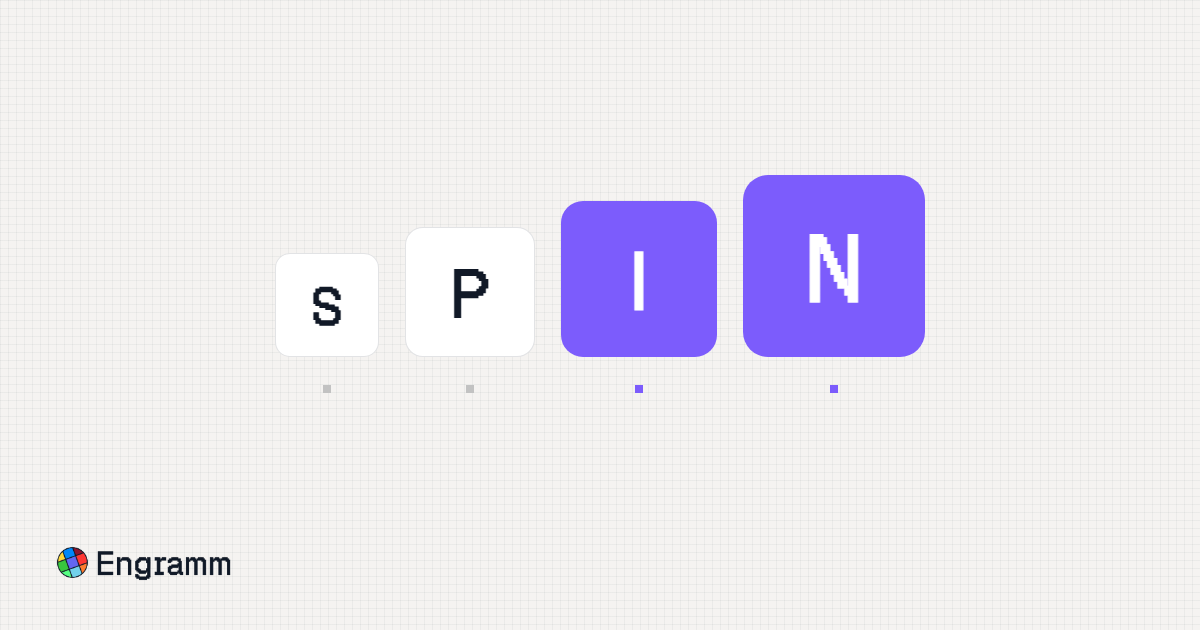
SPIN is an acronym for the four types of questions a rep asks during discovery. The rep starts with the facts, such as the customer's organization, tools or volumes (Situation), then looks for what isn't working (Problem). Next they explore what those difficulties do to costs, deadlines or teams (Implication), and finally get the customer to say what solving them would be worth (Need-payoff).
The order of the letters follows the usual flow of a discovery meeting. Huthwaite International, founded by Neil Rackham, teaches the method and owns the SPIN trademark. It describes SPIN as a flexible framework, in which the rep asks more situation questions or moves quickly to consequences, depending on the conversation.
In short
SPIN sorts discovery questions into four types: situation, problem, implication and need-payoff. The order of the letters follows the flow of the meeting, which the rep adapts to the conversation.
Where SPIN selling comes from.
In the early 1970s, Neil Rackham and his team began studying what successful salespeople did during their meetings. According to the publisher's description of the book, they analyzed more than 35,000 sales calls made by 10,000 salespeople in 23 countries, over twelve years. Rackham turned the findings into SPIN Selling, published by McGraw-Hill in 1988.
In an interview Huthwaite published in 2026, he explains how such a large sample came together. The team ran projects with companies such as Xerox, IBM and Motorola. Sales managers learned to code the questions asked during a call until they reached a 0.85 correlation with reference recordings. Each manager then observed three of their reps on a baseline call and coached them over five more calls, recording their questions again.
The study concluded that several methods designed for small sales don't work in large ones. Huthwaite points to closing techniques, which turned out to be counterproductive in those sales, and to presenting a product's features and benefits without tying them to a customer need. Successful sellers explored the customer's needs in depth and showed how their offer met them before trying to close.
Rackham also reports that the first thousand people trained on the SPIN model sold 17% more than control groups. He credits the whole program, in which each rep was observed and coached by their manager over several calls, and adds that the four questions alone don't explain the gap. These results come from Rackham and Huthwaite, and we found no independent study that replicates them.
In short
SPIN selling comes from Neil Rackham's team observing more than 35,000 sales calls, published in 1988. The figures behind it come from Rackham and Huthwaite.
The four types of SPIN selling questions, with B2B examples.
The examples follow a scheduling software vendor meeting the VP of operations at a regional trucking company.
Situation questions, the facts
- What you're trying to learn
- How the customer works today: their organization, tools, volumes, who does what. These questions set up the next ones, but the customer gets nothing out of them and tires of them quickly.
- Examples
- “How many trucks head out each morning, and who builds the routes?”
“What tool do you use for scheduling today?” - Watch out for
- Anything on the customer's website or in your CRM should be looked up before the meeting.
Problem questions, the difficulties
- What you're trying to learn
- What isn't working and what frustrates the customer, without talking about a solution yet. Each problem the customer acknowledges is an implied need.
- Examples
- “Do your routes hold up when a driver calls in sick or a customer moves their delivery window?”
“What takes up most of your dispatchers' time in the morning?” - Watch out for
- A customer can acknowledge a problem and have lived with it for years. Pitching your offer at this point is premature.
Implication questions, the consequences
- What you're trying to learn
- What the problem does to the business, such as overtime, late deliveries or customers threatening to leave. These questions give weight to a problem the customer considered tolerable. They're the hardest to ask, because you need to know the customer's business.
- Examples
- “When a route gets rebuilt the same morning, how much overtime does that add up to over a month?”
“Has a shipper ever brought up these delays when renegotiating their contract?” - Watch out for
- They build on what the customer just said. Applied to a problem the customer hasn't acknowledged, they come across as staged.
Need-payoff questions, the value of a solution
- What you're trying to learn
- What solving the problem would be worth to the customer, in their own words. The customer states the benefit of a solution themselves, and can repeat it to the other people involved in the decision.
- Examples
- “If routes recalculated automatically when a driver was out, what would your dispatchers do with their morning?”
“What would on-time deliveries change in your relationship with that shipper?” - Watch out for
- A closed question that pushes for agreement, like “You'd like to save time, right?”, doesn't get the customer to say anything.
Template to download: SPIN discovery worksheet and observer's scorecard
The four question types with an example and a watch-out for each, a sheet to fill in before and during discovery, and the observer's scorecard for the roleplay exercise, as a two-page PDF.
In short
Situation and problem questions help you understand the customer. Implication and need-payoff questions lead them to measure what the problem costs them and what a solution would be worth.
From implied needs to explicit needs.
The method distinguishes two kinds of needs. An implied need is a problem or dissatisfaction the customer voices, such as “scheduling eats up so much of our time.” An explicit need is a specific want, such as “we need a tool that rebuilds routes when a driver is out.”
Huthwaite points out that customers can live with a problem for a long time. They look for a solution once, in their eyes, the problem costs more than the price and risk of a change. Implication questions bring that cost to the surface, and need-payoff questions then lead the customer to state an explicit need.
A rep who presents the offer at the first implied need skips both steps. The customer hears a solution to a problem they still consider minor, and the price seems out of proportion.
In short
A problem the customer acknowledges is still an implied need. Implication and need-payoff questions turn it into an explicit need, stated by the customer.
When to use the SPIN selling technique.
Rackham's book is about large sales: a high price, several meetings, several people involved in the decision, and a buyer who will have to justify the spend. That covers enterprise software, medical devices and industrial sales, where an engineering and finance committee decides after several meetings.
For a short sale closed in a single call, like adding an option to a subscription, a few situation and problem questions do the job. Running through all four types of questions makes the call longer without changing the decision.
A customer who is already comparing vendors has done part of the work alone. Huthwaite advises cutting back on situation questions in that case, since the customer settled those answers long ago, and starting from what they have already established.
In short
The SPIN selling technique is built for large sales, with several decision-makers and several meetings. For a short sale, a few situation and problem questions do the job.
The most common mistakes.
The most frequent one is firing off situation questions. They feel safe to the rep, while the customer gets bored or feels interrogated. Huthwaite observes that successful sellers ask few of them and choose them more carefully. Information found before the meeting can be checked in one sentence (“You opened a second warehouse this year, right?”).
Implication questions can also turn into dramatizing. If the customer hasn't acknowledged any problem, asking about the consequences of a hypothetical incident looks like a maneuver, and they shut down. One or two implication questions drawn from what they just said, followed by a paraphrase, measure the weight of a problem better.
For Huthwaite, the most widespread mistake among people who have learned the method is applying it mechanically, reciting the four types of questions in order whatever the customer answers.
| Mistake | What the rep says | What to say instead |
|---|---|---|
| A barrage of situation questions | “How many trucks? What software? Since when?” | “I saw you added about ten trucks this year. How did routing keep up?” |
| Forced implication | “What would happen if two drivers were out on a peak day?”, when the customer hasn't mentioned any problem | Go back to a problem question: “What makes you rebuild a schedule the same morning?” |
| Solution too early | “Our tool does exactly that.” | “When that happens, what does it mean for your customers?” |
| Closed need-payoff | “You'd like to save time, right?” | “What would your dispatchers do with that time?” |
In short
Too many situation questions, implications pinned on a problem the customer hasn't acknowledged, and a sequence recited in order all lose the customer's attention.
SPIN, MEDDIC, BANT and SONCAS.
SPIN describes how to question the customer during discovery. The other three frameworks in the table serve other stages of the sale, and teams often combine them.
| Framework | What it's for | Stage of the sale |
|---|---|---|
| SPIN | Running discovery with four types of questions | Discovery meetings, large sales |
| BANT | Checking budget, authority, need and timeline | First call, lead screening |
| MEDDIC, MEDDPICC | Tracking the six or eight criteria of a complex deal | From discovery to signature |
| SONCAS | Spotting the buying motives of the person you're talking to | Discovery and argumentation |
Implication questions feed two MEDDIC criteria, Identify pain and Metrics, which the customer then needs to own. Our guide to MEDDPICC and MEDDIC gives a scorecard to track them from one meeting to the next. With the BANT sales methodology, need is the criterion SPIN questions move forward, and many teams start their qualification call with it.
Answers to problem and implication questions also show what matters to the person in front of you, such as security or money, two of the motives in the SONCAS method, a framework widely taught in France. To prepare the whole meeting, our guide to discovery questions offers a template.
In short
SPIN structures discovery questions. BANT and MEDDIC check what has been learned, and SONCAS guides the argument.
Practicing SPIN questions in a roleplay.
In a meeting, the rep picks the next question in a few seconds, based on the answer they just heard. Reps learn this in front of an observer who logs each question, as the managers in Rackham's projects did. The exercise takes three people: a rep, a customer and an observer.
- The trainer writes the customer brief: the company, its situation, two problems the customer acknowledges if asked, and their consequences, which the customer has never put a number on. It also covers what holds the customer back from changing, for example a tool installed two years ago.
- The rep gets one page of public information about the company. They run a twenty-minute discovery and only present the offer once they have an explicit need.
- The customer gives short answers to situation and problem questions. They only talk about consequences when asked, and only state an explicit need after a need-payoff question.
- The observer tags each question (S, P, I or N) and notes when the rep brings up the offer.
- Compare with the brief, then run it again with a customer in a hurry, who cuts situation questions short.
| Criterion | What to observe |
|---|---|
| Situation | Number of questions, and how many had answers in the public information |
| Problems | Were both problems in the brief uncovered? |
| Implications | Questions asked about those problems and consequences obtained |
| Need-payoff | Did the customer say in their own words what a solution would bring? |
| Offer | When the rep presented the offer |
With colleagues, each run ties up three people and depends on how well the customer plays the part. In Engramm's voice roleplays, the scenario follows the brief: what the customer shares readily, what they only reveal when asked, and what makes them hesitate. The character answers in under 500 ms and only talks about the consequences of their problems when the rep leads them there. The scorecard follows your criteria, for example one per question type, and each call's metrics count open questions and measure the rep's talk time. The AI coach then goes back over the consequences the rep didn't explore.
In short
SPIN is practiced in threes, with a customer brief that hides the consequences of the problems and an observer who tags each question.
Frequently asked questions.
What is SPIN selling?
SPIN selling is a discovery method for complex sales, published by Neil Rackham in 1988 after his team observed more than 35,000 sales calls. It sorts a rep's questions into four types: Situation, Problem, Implication and Need-payoff.
What types of questions are included in SPIN?
Situation questions (facts about the customer and their organization), Problem questions (their difficulties), Implication questions (the consequences of those difficulties) and Need-payoff questions (what solving the problem would be worth to them).
Does SPIN selling still work?
Huthwaite International still teaches it. It recommends asking fewer situation questions, since reps can now find many of the answers online, and taking into account how far the customer has progressed in their buying process. The published figures come from Neil Rackham and Huthwaite, and we found no recent independent study measuring its effect.
What's the difference between SPIN selling and MEDDIC?
SPIN is a questioning method for discovery. MEDDIC is a qualification framework that lists what you need to know about a complex deal, such as the economic buyer or the decision process. SPIN's implication questions help fill in two MEDDIC criteria, Identify pain and Metrics.
Sources.
- Neil Rackham, SPIN Selling, McGraw-Hill, 1988, catalog record: archive.org; description of the Routledge edition: routledge.com
- Huthwaite International, “Neil Rackham explains the extensive research behind SPIN Selling”, video interview and transcript, April 23, 2026: huthwaiteinternational.com
- Rachel Massey, “SPIN Selling: A Complete Guide to Sales Success”, Huthwaite International, June 24, 2021: huthwaiteinternational.com
- Hayley Ramsey, “Exploring the power of SPIN Selling questions (with examples)”, Huthwaite International, September 21, 2023: huthwaiteinternational.com
- Tony Hughes, “Rethinking SPIN® – the universal framework for persuasive communication”, Huthwaite International, May 22, 2025: huthwaiteinternational.com