The 30-60-90 day sales onboarding plan: how to ramp up a new rep
Sales onboarding is the period in which a new rep learns the company's offer, customers, tools and way of selling, until they can run meetings and carry a quota on their own. It is often organized as a 30-60-90 day sales plan, with goals and deliverables for each month. According to The Bridge Group, account executives take 6.2 months on average to reach full productivity.

What a rep must be able to do before their first solo meeting.
A new rep arrives with their own experience, but without the offer, the customers and the habits of their new employer. In a 2010 guide published by the SHRM Foundation, the foundation of the Society for Human Resource Management, Talya Bauer, then a professor of management at Portland State University, describes four levels of onboarding, the “Four C’s”: compliance, clarification, culture and connection. Clarification means making sure the employee understands the job and what is expected of them.
Before the first solo meeting, clarification covers five areas, and each is checked in a different way.
| Area | What it covers | How to check it is in place |
|---|---|---|
| Offer | Products, pricing, terms, what sets the offer apart from competitors | A quiz, then a ten-minute pitch to the manager |
| Customers | Target industries, typical buyers, problems the offer solves, reference customers | The rep describes three existing customers and explains why they bought |
| Tools | CRM, quoting tool, calendar, phone system | They create an account, an opportunity and a quote without help |
| Sales methodology | Stages of the cycle, qualification criteria, exit criteria for each stage | They qualify a mock deal with the company’s methodology |
| Conversation | Opening, discovery, presenting the offer, handling objections, next step | Full meetings in roleplay, scored on a rubric |
The first four areas can be checked with a quiz, a pitch or an exercise in the tool. Conversation takes full meetings, played and then scored. For qualification, our guides on BANT and on MEDDIC and MEDDPICC cover two frameworks common in B2B sales.
Culture and connection come through the team: a mentor, introductions to the teams that work with sales (sales operations, marketing, presales), and a seat at team meetings from week one.
In short
Before their first solo meeting, a rep needs to know the offer, its customers, the tools and the sales methodology, and to have run full meetings in roleplay.
What research says about onboarding new hires.
In 2007, Talya Bauer and four colleagues pooled 70 samples of new employees in a meta-analysis published in the Journal of Applied Psychology. Their model places three things between what a company does to onboard new hires and what follows (performance, satisfaction, commitment, intention to stay, turnover): role clarity, the sense of being able to do the job, and acceptance by the team.
In her 2010 guide, Bauer notes that role clarity is among the most consistent predictors of satisfaction and commitment during onboarding, and it can be measured by asking new hires whether they understand what is expected of them. Self-efficacy affects commitment, satisfaction and turnover, and she recommends programs designed to build it.
The psychologist Albert Bandura described self-efficacy in 1977. He named four sources for it: performance accomplishments, watching others, persuasion and physiological state. In the experiments he reports, run with people who had phobias, those who performed the feared actions themselves gained more confidence than those who watched a therapist do them.
Riding along with a senior rep, which the U.S. Bureau of Labor Statistics describes for wholesale and manufacturing sales representatives, is a form of watching others. A successful discovery roleplay gives the new rep a first experience of success before their first customer.
In short
Role clarity, self-efficacy and acceptance by the team link onboarding to performance and turnover. Roleplay gives a new rep a first experience of success before their first customer.
The 30-60-90 day sales plan for a new rep.
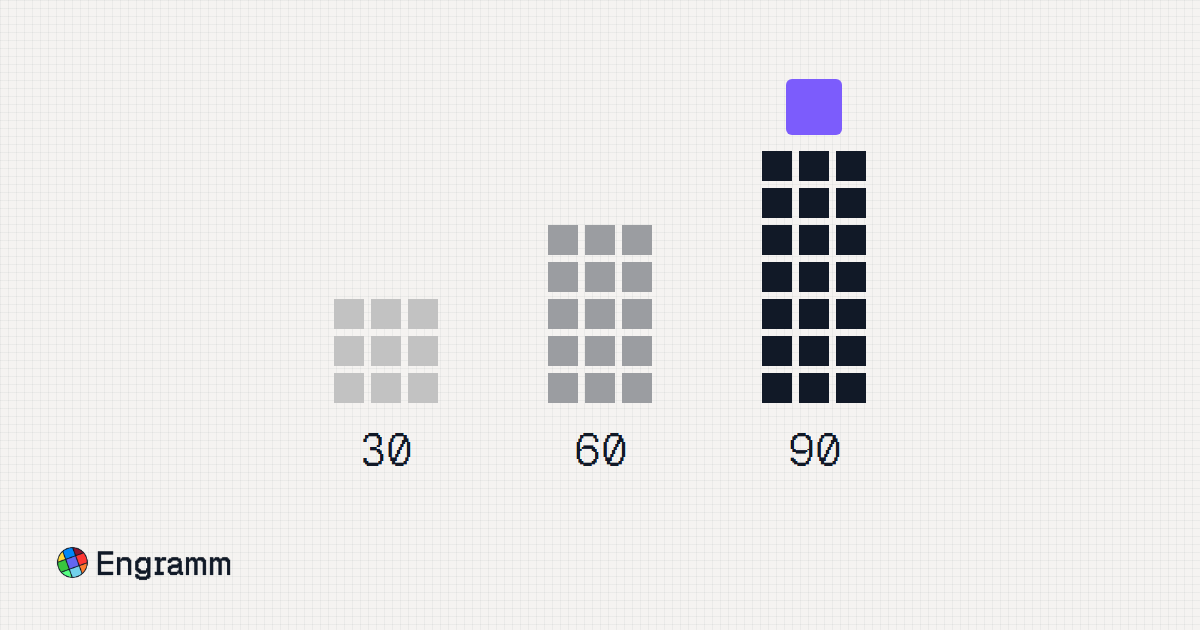
In 2003, Michael Watkins, then a professor at Harvard Business School, wrote a book about a manager’s first 90 days in a new role, The First 90 Days, which has sold more than 1.5 million copies according to IMD, where he teaches today. The 30-60-90 day plan uses the same three-month horizon and splits it into three periods. We could not find who first proposed that split. Talya Bauer, for her part, recommends a written onboarding plan and check-ins at 30, 60, 90 and 120 days, and up to one year.
For a sales rep, each month has a goal, deliverables the manager can check, and a sign-off before the next month. The plan below fits a B2B sales cycle of a few weeks to a few months. The figures in the deliverables are examples to adjust.
Days 1 to 30: learn the offer and practice
- Goal
- Know the offer, the customers and the tools, and pass roleplays of the first meetings in the sales cycle.
- What the rep does
- Courses on the offer and the sales methodology, listening to recorded calls, ride-alongs with a senior rep, and prospecting and discovery roleplays.
- Deliverables
- A ten-minute pitch of the offer to the manager, a list of qualified target accounts in the CRM (50, for example), roleplay scores above the agreed threshold.
- Day 30 sign-off
- A review of these deliverables with the manager and a quiz on the offer. The manager then clears the rep for their first supported meetings.
Days 31 to 60: run first meetings, with support
- Goal
- Run real meetings with the manager or a mentor in the room, and build a pipeline.
- What the rep does
- Prospecting every day, discovery meetings the rep leads, a debrief after each one, and roleplays on the pitch and on objections, replaying the moments that went wrong with a real customer.
- Deliverables
- A number of meetings run, set with the manager, the first qualified opportunities in the CRM and notes for each meeting.
- Day 60 sign-off
- The manager scores two real meetings with the roleplay rubric. The rep moves on to solo meetings once every criterion reaches the expected level.
Days 61 to 90: sell alone
- Goal
- Run deals alone up to the proposal, with a first, reduced quota.
- What the rep does
- Solo meetings, proposals, negotiations rehearsed in simulation before the real ones, and a coaching session every week.
- Deliverables
- The first proposals sent, a pipeline that covers next quarter's quota, an account plan for their top three customers or prospects.
- Day 90 sign-off
- A review with the manager: activity, pipeline, scores by criterion, next quarter's quota and areas to work on.
Template to download: 30-60-90 day sales plan for a new rep
Goals, deliverables and sign-off for each month, to fill in with the new hire on day one, then the onboarding checklist, as a two-page PDF.
In short
A 30-60-90 day sales plan gives a new rep a goal, deliverables and a sign-off for each month: learn and practice, sell with support, then sell alone.
The sales onboarding process: a checklist.
Several items are settled before the rep starts. The checklist follows the order in which things happen, with the person responsible for each item.
| When | What to do | Who |
|---|---|---|
| Before day one | Access to the CRM, email, phone and quoting tool | IT, sales operations |
| Before day one | Territory or book of business defined, inherited accounts listed with their history | Manager |
| Before day one | Mentor assigned, first ride-alongs scheduled | Manager |
| Before day one | Training program scheduled: courses, quizzes, roleplays | Training lead |
| Day 1 | Welcome from the manager, 30-60-90 day plan handed over and explained | Manager |
| Week 1 | Introductions to sales operations, marketing, presales and customer support | Rep, mentor |
| Week 1 | Courses on the offer and the sales methodology, listening to recorded calls | Rep, training lead |
| Weeks 2 to 4 | Ride-alongs, prospecting and discovery roleplays, weekly debrief | Rep, mentor, manager |
| Before the first solo meeting | Offer quiz passed, pitch approved, roleplays above threshold, CRM in use | Manager |
| Days 30, 60 and 90 | Review of deliverables and decision on the next stage | Manager, rep |
| Day 90 | Survey of the rep on what helped and what was missing | Training lead |
The day-90 survey is used to improve the program for the next class.
In short
The checklist starts before day one, with access, the territory, a mentor and the training program, and ends with the 90-day review.
Average ramp time by sales role.
Ramp time is the time between a rep’s start date and the point where they reach the productivity expected of an experienced rep, often their full quota. Each company defines it its own way, which makes comparisons shaky.
The most detailed figures we found come from The Bridge Group, a U.S. firm that has surveyed B2B sales leaders every two years since 2006. In its 2026 study of 158 companies, account executives, the reps who run deals through to signature, took 6.2 months on average to reach full productivity. That is the longest in the study’s history, which the firm links to more complex deals and larger buying committees.
For sales development reps (SDRs), who handle prospecting, the firm’s 2025 study puts average ramp time at 3 months, the lowest since 2010. It covers 351 companies, 78% of them in North America and 83% software companies.
| Role | What they do | Benchmark | Source |
|---|---|---|---|
| SDR or BDR | Prospecting and booking meetings | 3 months on average to full productivity | The Bridge Group, 2025, 351 companies |
| Account executive | Running deals through to signature | 6.2 months on average to full productivity | The Bridge Group, 2026, 158 companies |
| Wholesale and manufacturing sales rep (U.S.) | Selling to businesses, government agencies and distributors | Formal training programs that can last up to a year | Bureau of Labor Statistics |
For an internal benchmark, look at how many months your last three hires took to reach full quota.
During that period, the rep’s quota ramps up in steps. The table below is an example of an account executive ramp-up template over six months, close to the 2026 average, to adjust to your sales cycle.
| Month | Share of full quota | What is expected of the rep |
|---|---|---|
| 1 | 0% | Training, roleplays, ride-alongs |
| 2 | 0% | Supported meetings, first opportunities in the CRM |
| 3 | 25% | First solo meetings, first proposals |
| 4 | 50% | A pipeline that covers next month’s quota |
| 5 | 75% | Regular closed deals |
| 6 | 100% | The quota of an experienced rep |
An illustrative stepped ramp: it is not an observed average.
In short
According to The Bridge Group, account executives take 6.2 months on average to reach full productivity and SDRs 3 months. Quota ramps up in steps during that period.
How to measure ramp-up.
Ramp time can only be measured after the fact. To manage a class of new hires during their first weeks, the manager and the training lead need indicators that move earlier.
| Indicator | What it measures | When to read it |
|---|---|---|
| Roleplay scores by criterion | What the rep can do in a meeting: discovery, pitch, objections, next step | Every week, from week one |
| Quiz results | What they know about the offer, pricing and terms | Weeks 1 to 4 |
| Activity | Calls, meetings booked, meetings run | Every week from month two |
| Pipeline | Qualified opportunities and their value | Days 60 and 90 |
| Time to first deal | Time until the first signed sale | At signature |
| Ramp time | Time until full quota | At the end of the ramp |
| Role clarity | How well the rep understands what is expected of them | Days 30 and 90, by survey |
| Turnover | Departures at three and six months | Three and six months after the start date |
| Manager time | Hours spent on one-on-one support | Every month |
Roleplay scores are available from week one, long before the first sales results. Read criterion by criterion, they tell the manager what to work on in one-on-ones: discovery, the move to pricing or the next step.
A score earned in simulation measures what the rep can do in the simulation. On day 60, the manager scores two real meetings with the same rubric and compares the two sets of scores.
From one class to the next, compare time to first deal and departures at six months. Those two indicators show whether a change to the program had an effect.
In short
Roleplay scores and quizzes move from week one. Time to first deal and departures at six months are compared from one class to the next.
Preparing first meetings in simulation.
In the first month, each roleplay needs a trainer or a colleague to play the customer, and each new hire gets few turns. Our guide to sales roleplay scenarios offers ten scripts and a rubric for running them in a group.
With Engramm, the program is built from your documents. Product sheets and the sales methodology become interactive courses, presented by an AI coach that answers each new hire’s questions and checks what they understood. The meetings in the plan become voice roleplays: the simulated customer responds in under 500 ms, and every attempt is scored on your rubric. On the dashboard, the manager tracks each new hire criterion by criterion and sets the score required before the first solo meeting. Our page on Engramm’s sales onboarding software walks through a typical five-week program.
At Adecco, 65 sales reps practiced prospecting with six simulated prospect profiles. With the same number of meetings, they produced 6% more sales proposals, as Matthieu Le Beurier, a regional sales director, explained in a webinar on conversational AI in training (in French). The team was already in place.
What is covered in the first month fades fast without review, as the forgetting curve shows. Plan short roleplays and quizzes through day 90 and beyond.
To get started, take the two meetings your new hires run first, often the prospecting call and discovery. Write a scenario for each with two customer profiles, and have your next class play them before their first ride-along.
In short
With courses on the offer, roleplays scored on your rubric and a dashboard, the manager signs off on each new hire before their first solo meeting.
Frequently asked questions.
What is a 30-60-90 day sales plan?
It is an onboarding plan that sets goals, deliverables and a check-in for each of the first three months in a role. For a sales rep, month one is for learning the offer and practicing, month two for running meetings with support, and month three for selling alone against a first, reduced quota.
What are the 4 C's of onboarding?
In her guide for the SHRM Foundation, Talya Bauer describes four levels: compliance (rules and internal policies), clarification (understanding the job and what is expected), culture (formal and informal norms) and connection (relationships and information networks). In her view, how far a company works on these four building blocks sets its level of onboarding.
What is the average ramp time for a sales rep?
According to The Bridge Group, account executives take 6.2 months on average to reach full productivity (2026 study, 158 B2B companies), and sales development reps take 3 months (2025 study, 351 companies). 78% of the companies in the second study are in North America.
What is a sales ramp-up plan?
A ramp-up plan sets how a new rep’s quota rises during their first months, for example 0% in months one and two, then 25%, 50%, 75% and 100% of full quota. It goes with the 30-60-90 day plan, which sets what the rep learns and delivers in each period.
Sources.
- Talya N. Bauer, Todd Bodner, Berrin Erdogan, Donald M. Truxillo and Jennifer S. Tucker (2007), “Newcomer adjustment during organizational socialization: A meta-analytic review of antecedents, outcomes, and methods,” Journal of Applied Psychology, 92(3), 707-721: pubmed.ncbi.nlm.nih.gov
- Talya N. Bauer, Onboarding New Employees: Maximizing Success, SHRM Foundation, 2010, PDF copy hosted by the University of Georgia: studentaffairs.uga.edu
- Albert Bandura (1977), “Self-efficacy: Toward a unifying theory of behavioral change,” Psychological Review, 84(2), 191-215: pubmed.ncbi.nlm.nih.gov; summary by the Stanford Center on Longevity: longevity.stanford.edu
- Michael Watkins, The First 90 Days: Critical Success Strategies for New Leaders at All Levels, Harvard Business School Press, 2003, Publishers Weekly listing: publishersweekly.com; IMD, faculty profile of Michael Watkins: imd.org
- The Bridge Group, AE Models, Motions & Metrics: 2026 Research Report, June 22, 2026: bridgegroupinc.com
- The Bridge Group, Sales Development Models, Metrics & Compensation: 2025 Research Report, February 6, 2025: bridgegroupinc.com
- U.S. Bureau of Labor Statistics, Occupational Outlook Handbook, “Wholesale and Manufacturing Sales Representatives,” accessed October 30, 2026: bls.gov