How to conduct a job interview: interview training for managers and recruiters
To conduct a job interview, the method best supported by research is to ask every candidate the same questions, drawn from the role's competencies, to follow up until you get facts, and to score the answers on a shared scorecard. A manager who hires two or three times a year gets few chances to practice this: they reread the résumé fifteen minutes beforehand, improvise some of their questions and come out of the interview with an impression. A candidate simulated by AI lets them practice before the next hire.

- For
- Hiring managers, recruiters, HR business partners
- Duration
- 10 minutes per simulated interview
An interview everyone runs their own way.
An insurance company is hiring a team lead for its contact center. The recruiter follows her usual outline. The future manager opens with “Tell me about yourself,” then spends twenty minutes describing the job. The department head asks two trick questions to see how the candidate reacts.
When it's time to decide, the three opinions can't be compared, since nobody asked the same questions. The candidate, for his part, recited his answers to the classic questions. He would only have described what he did in a specific situation if someone had asked.
In short
Without a shared guide, interviewers' opinions can't be compared, and facts only come out when someone asks for them.
What research says about structured interviews.
In 2022, Paul Sackett and three colleagues revisited the meta-analyses on the validity of selection methods, summarized in 1998 by Frank Schmidt and John Hunter, with more conservative corrections. The structured interview comes out on top of the methods studied. Under the U.S. Office of Personnel Management's definition, every candidate gets the same questions, and the answers are scored on the same scale.
That average hides large differences: by the same calculations, the validity of structured interviews falls below .18 in one case out of ten.
How the interview is run also affects when the interviewer makes up their mind. In 2016, Rachel Frieder and two colleagues surveyed 166 interviewers about 691 applicants. About 30% of decisions came in the first five minutes, according to the British Psychological Society's summary, and asking every applicant the same questions delayed the decision.
In short
According to the 2022 review, the structured interview is the most predictive selection method, and it delays the moment the interviewer makes up their mind.
The scenario: conducting a job interview with a simulated candidate.
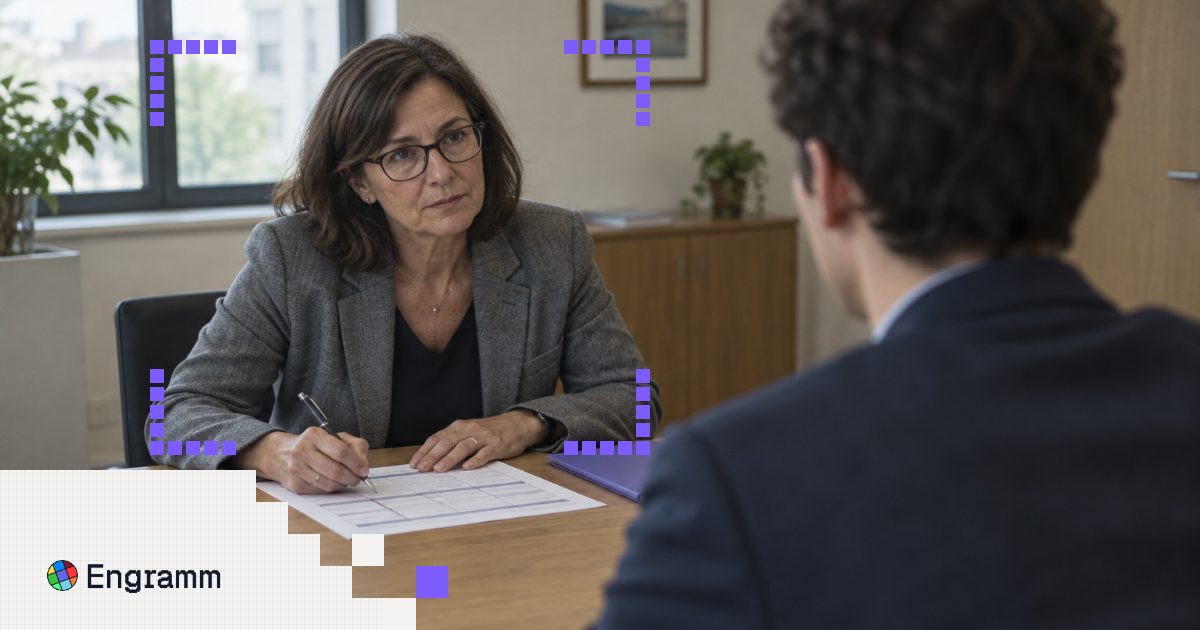
The AI plays a candidate for the team lead role. The learner runs a ten-minute interview on three competencies from the guide: leading a team, handling a disagreement, tracking the department's metrics.
| Element | What the scenario sets up |
|---|---|
| The character | Kevin Walsh, a supervisor for five years in another insurer's contact center, in the final round at another company |
| What he says up front | A polished career story and successes told in the plural: “We raised customer satisfaction across the whole team.” |
| What he keeps to himself | He has never handled a difficult conversation with an employee on his own. He only says so if the interviewer asks what he did personally, then follows up |
| At the end of the interview | He asks about the salary range, remote days and why the role is open |
| The learner's goal | One real example per competency with no leading questions, accurate answers, ten minutes respected and the role's scorecard filled in right afterwards |
In short
The candidate only reveals his weak spots to an interviewer who follows up.
The interview, step by step, and its scorecard.
The scorecard rates the interviewer, following the steps of the interview in order.
| Step | What the scorecard looks for |
|---|---|
| 1. Opening | Introduction, format and length explained |
| 2. Guide questions | The planned questions, in the same order for every candidate |
| 3. Follow-ups | For every general answer, a request for an example: the situation, the candidate's own action, the result |
| 4. Presenting the role | After the questions, in a few minutes |
| 5. Candidate questions | Accurate answers, with no promises |
| 6. Closing | Next steps and response time explained, the interview ends on time |
| 7. Scoring | Each competency scored right after, with the facts noted |
From start to finish, the candidate should do most of the talking, and no question should suggest the answer (“You handle pressure well, I assume?”) or stray from the job. For questions that have no place in an interview, the U.S. Equal Employment Opportunity Commission sets out the rules on pre-employment inquiries on its page on prohibited employment policies and practices.
In Engramm, these criteria become the scenario's scorecard, and the AI coach goes over any leading questions with the interviewer. Other candidate profiles are on the page about recruiter training.
Template to download: job interview scenario sheet and scorecard
The trainer's scenario sheet, with what the candidate keeps to himself and the variants, then the observer's scorecard, as a two-page PDF.
In short
The interviewer is scored step by step, from the opening to the final scoring.
Interview training for managers before the next hiring push.
Start from the next open role. HR writes the interview guide, three or four competencies with two questions each, then builds the simulated candidate from the job description. Each panel member runs the interview, and the panel compares scores before meeting the first candidate. The gaps show vague criteria and interviewers who rarely follow up.
Plan a second session before the next hiring push, since the forgetting curve shows what is lost without review. A feedback conversation or a difficult conversation with an employee can be prepared the same way.
In short
Have the whole panel run the simulated interview before each hiring push, then compare scores.
Frequently asked questions.
How do you conduct a job interview as a hiring manager?
Prepare an interview guide with the role's competencies and two questions per competency. Explain how the interview will run, ask the planned questions and ask for a specific example whenever an answer stays general, then answer the candidate's questions. Score each competency right after the interview, with the facts behind each score.
What questions should you ask in a job interview?
The same questions for every candidate, tied to the role's competencies. A question about a past situation, such as “Tell me about a disagreement with someone on your team and what you did,” brings out facts, and follow-ups fill in the rest.
What questions can't you ask in a job interview?
The U.S. Equal Employment Opportunity Commission explains the rules on pre-employment inquiries on its page on prohibited employment policies and practices, which is freely available.
Sources.
- Paul R. Sackett, Charlene Zhang, Christopher M. Berry and Filip Lievens (2022), “Revisiting meta-analytic estimates of validity in personnel selection: Addressing systematic overcorrection for restriction of range”, Journal of Applied Psychology, 107, 2040-2068, Table 3: doi.org
- Frank L. Schmidt and John E. Hunter (1998), “The validity and utility of selection methods in personnel psychology: Practical and theoretical implications of 85 years of research findings”, Psychological Bulletin, 124(2), 262-274, values as reported in Table 3 of Sackett et al. (2022): doi.org
- Rachel E. Frieder, Chad H. Van Iddekinge and Patrick H. Raymark (2016), “How quickly do interviewers reach decisions? An examination of interviewers' decision-making time across applicants”, Journal of Occupational and Organizational Psychology, 89(2), 223-248: doi.org
- British Psychological Society, Research Digest, summary of the study by Frieder, Van Iddekinge and Raymark, May 8, 2015: bps.org.uk
- U.S. Office of Personnel Management, “Structured Interviews”: opm.gov
- U.S. Equal Employment Opportunity Commission, “Prohibited Employment Policies/Practices”: eeoc.gov