The Kirkpatrick model: four levels of training evaluation, with sales examples
The Kirkpatrick model evaluates training on four levels: how participants react, what they learn, what they apply on the job, and the results for the business. Donald Kirkpatrick published it in 1959 and 1960. We go through each level with a sales training example, then the model's criticisms, Phillips' Level 5 (ROI) and what a scored roleplay can measure.

What the Kirkpatrick model is.
Each level of the model answers its own question and calls for its own tools: an end-of-session survey, a test or a skills demonstration, on-the-job observation, then the company's own metrics. Moving up the levels, measurement takes longer and it gets harder to attribute a change to the training alone.
Practitioners also distinguish immediate evaluation, at the end of the session, from delayed evaluation, a few weeks or months later. Levels 1 and 2 are mostly measured right away. Levels 3 and 4 have to wait until participants have had a chance to apply what they learned.
In short
The model evaluates training on four levels, each with its own tools. The first two are mostly measured at the end of the session, the last two weeks or months later.
Donald Kirkpatrick's articles, 1959 and 1960.
Donald Kirkpatrick spent most of his career at the University of Wisconsin's Management Institute, where he trained managers. He set out the four levels in the 1950s, around the time of his PhD dissertation, which evaluated a human relations training program for supervisors.
He presented them in a four-part series, “Techniques for Evaluating Training Programs,” published in the Journal of the American Society of Training Directors from November 1959 to February 1960, one article per level. He called them “steps”; the word “levels” came later.
The third article opens with a memory from 1949. During a week-long human relations course, a foreman from a Milwaukee company named Herman was the first to raise his hand at every question and always had the right answer. Kirkpatrick's cousin, who worked for Herman, told him that on the job Herman paid little attention to his team's ideas and feelings. Kirkpatrick took from this that there can be a big gap between knowing principles and using them at work.
In short
Donald Kirkpatrick published the four levels between November 1959 and February 1960. The idea for Level 3 came from a foreman who knew the right principles but did not apply them.
The four levels, with a sales training example.
The cards follow the same program through each level: two days on discovery meetings for the 30 field sales reps of an electrical supplies distributor who sell to contractors and engineering firms.
Reaction
- What it measures
- What participants think of the training and how they plan to use it. Kirkpatrick defined it as how well trainees liked the program.
- How
- An anonymous end-of-session survey, with rating scales so answers can be tallied and room for comments, as Kirkpatrick recommended in 1959.
- Example
- Reps rate how useful each module will be for next month's meetings. The account planning module scores low, because few of them write account plans.
Learning
- What it measures
- What participants know and can do at the end of the training, which Kirkpatrick described as the principles, facts and techniques understood and absorbed.
- How
- A test before and after, so the gain can be tied to the program. For a skill, a demonstration during the session, since written questions cannot measure a skill accurately, as Kirkpatrick Partners points out.
- Example
- A quiz built from the training materials, on the first morning and the last afternoon. Each rep also runs the same discovery conversation at the start and at the end, scored on a shared rubric: open questions, rephrasing, need and budget identified.
Behavior
- What it measures
- What participants apply back on the job, especially the few behaviors that weigh most on results.
- How
- On-the-job observation compared with the situation before training, by the participant, their manager, their direct reports or their peers. Kirkpatrick advised waiting at least three months and comparing with a group that was not trained.
- Example
- Three months later, each manager joins two first meetings per rep, with the rubric from the training. In the CRM, you check that the need and the stakeholders are logged.
Results
- What it measures
- The effects on what the company is trying to achieve. Kirkpatrick listed lower costs and absenteeism or higher production; for a sales team, you track conversion rate, deal size and margin.
- How
- Metrics the company already tracks, compared before and after, ideally against a team not yet trained. Kirkpatrick called the difficulty of telling the effect of training apart from other factors “the separation of variables.”
- Example
- The share of first meetings that lead to a quote, and the average quote value, over six months. Regions trained later serve as the comparison group.
Template to download: Kirkpatrick evaluation plan
A plan to fill in before the training, level by level starting from results, evaluation questions for the end of the session and later, and the Phillips ROI calculation, as a two-page PDF.
In short
Level 1 is measured with a survey, Level 2 with a test and a scored demonstration before and after, Level 3 with on-the-job observation after a few months, Level 4 with the company's metrics.
Training evaluation questions for each level.
Kirkpatrick Partners, the company that carries on Donald Kirkpatrick's work, publishes sample questions for Levels 1 and 2. It recommends keeping one or two per dimension, with a comment field. The examples below are adapted to our discovery training.
| Level | When | Question |
|---|---|---|
| 1. Relevance | End of session | “Will you be able to use what you practiced today in next month's meetings?” |
| 2. Knowledge | Before and after | “Name two questions that get a customer to talk about their budget.” |
| 2. Confidence | End of session | “Do you feel ready to run your next discovery meeting with this method? If not, what's holding you back?” |
| 3. Application | One to three months later | “In your last five first meetings, how many started with an open question about the customer's project?” |
| 3. Manager's view | One to three months later | “What have you seen change in the way they run discovery?” |
In short
One or two questions per dimension at Levels 1 and 2, including one on usefulness for the job. At Level 3, ask both the rep and their manager.
What the New World Kirkpatrick Model changed.
In the 2010s, Jim Kirkpatrick, Donald's son, and Wendy Kayser Kirkpatrick revised the model as the New World Kirkpatrick Model. They kept the four levels and asked that they be planned backward: expected results first, then the behaviors needed on the job, what has to be learned for that, and finally the format of the training.
| Level | What the New World Kirkpatrick Model adds |
|---|---|
| 1. Reaction | Three dimensions: satisfaction, participant engagement and relevance to their job. |
| 2. Learning | Attitude, confidence and commitment to apply, alongside knowledge and skills. |
| 3. Behavior | A few critical behaviors, and the on-the-job mechanisms that support them (required drivers): job aids, coaching, work review, recognition. |
| 4. Results | Leading indicators, measurable in the short term, such as customer satisfaction or sales volume. |
For a sales team, the most useful addition is at Level 3. A manager who uses the training rubric during ride-alongs is one of those mechanisms. We cover that role in our guide to sales coaching, and how to build the program itself in our guide to designing a sales training program.
In 2026, Kirkpatrick Partners extended the model to the work environment, which can derail a well-designed program if the organization does not support the change it aims for.
In short
The New World Kirkpatrick Model plans the four levels backward from the expected results and adds detail to each, especially the manager's role at Level 3.
Criticisms of the Kirkpatrick model.
Kirkpatrick himself warned in his first article that measuring reaction tells you nothing about learning, and that nearly all training directors collect it because it is easy to measure.
In 1989, writing in Personnel Psychology, George Alliger and Elizabeth Janak noted the model's “widespread and enduring popularity” and pointed out three implicit assumptions they considered problematic: each level provides more information than the one before, each is caused by the one before, and all four are positively correlated.
In 1996, Elwood Holton argued that the four levels classify training outcomes without explaining what produces them. The original model leaves out motivation to learn, participant characteristics and the conditions for transfer to the job.
In that meta-analysis, Alliger and four colleagues split reactions into “affective” ones, how much participants enjoyed the training, and “utility” ones, how useful they found it for their job. Utility reactions were more strongly related to learning and on-the-job application than affective reactions. They were even more strongly related to application than learning tests were.
In 2008, a meta-analysis led by Traci Sitzmann found no such difference between the two types of reactions in their link with learning. It showed that reactions mostly describe the course itself, especially the instructional style and the interaction during the session.
Each level therefore needs its own measure, and if the end-of-session survey has to stay short, the question about usefulness on the job is the one to keep.
In short
Criticisms focus on the assumed links between levels, especially between satisfaction and learning. A session people enjoyed does not guarantee learning or on-the-job application.
Phillips' Level 5 and sales training ROI.
Jack Phillips's ROI Methodology, now promoted by the ROI Institute, which he chairs, has five levels. The first four mirror Kirkpatrick's under other names. The fifth compares the program's benefits, converted to money, with its full cost, in six steps.
- Identify the improvement in business metrics.
- Isolate the share of that improvement due to the program.
- Convert it to money.
- Add up the fully loaded costs, including design, delivery, participants' time and evaluation.
- List the benefits you do not convert to money.
- Calculate ROI (%), which is net benefits divided by costs, times 100.
A sales training program that costs $60,000 all in, reps' time included, and is credited with $90,000 in additional margin over the year produces $30,000 in net benefits, for an ROI of 50%.
Worked example built for this guide.
The ROI Institute reserves this calculation for programs that are expensive, long-lived, broad in reach or aimed at significant change. Kirkpatrick Partners puts forward a “contributive ROI” instead, which estimates the share of improvement reasonably linked to training without isolating it as the sole cause, and a “Return on Expectations” agreed in advance with the program's sponsors.
In short
Phillips' Level 5 compares a program's benefits, converted to money, with its full cost, which requires isolating the training's share of the results.
What a scored roleplay can measure.
In a scored roleplay, the rep holds a full conversation with a simulated customer, and a rubric evaluates what they do: their questions, their rephrasing, how they handle objections. You are observing behavior, in a simulation.
In the Kirkpatrick model, that observation belongs to Level 2. Kirkpatrick already placed in-class demonstrations there, as they show whether a participant can apply a method, at least in a classroom setting, and the Alliger meta-analysis likewise counts skill demonstration among learning measures. A quiz checks that the rep knows the method; the roleplay shows whether they can use it.
It says nothing about what the rep will do in a real meeting. The simulated customer signs no order, the rep knows they are being assessed, and back at work they return to their habits and a full calendar. That move to the field is Level 3. Our use case on measuring training effectiveness on the job shows how to observe it on one specific behavior, before the training and a month later.
The simulation does prepare Level 3, because its rubric defines the expected behaviors, which the manager will then observe with the same criteria. Run before, during and after the training, the same scenario gives the before-and-after comparison Kirkpatrick recommended. Spaced sessions in the following weeks also maintain what fades quickly without review, as the forgetting curve shows.
In Engramm's AI roleplays, the customer is played by AI, by voice, and responds in under 500 ms. Each session ends with a scorecard based on your criteria, and dashboards track each rep's progress from one session to the next.
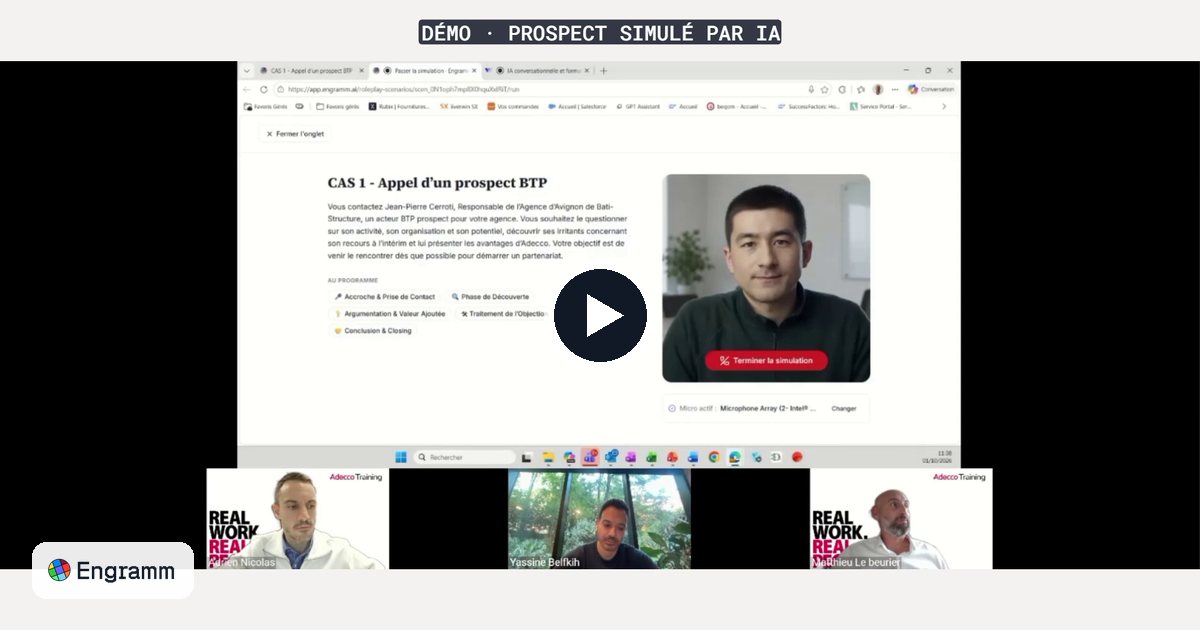
At Adecco, 65 sales reps attended a half-day classroom session, then practiced on six simulated prospect profiles. Their regional sales director reported 6% more sales proposals for the same number of meetings, in a webinar on conversational AI in training. In New World Kirkpatrick Model terms, that is a Level 4 leading indicator.
In short
A scored roleplay observes behavior in a simulation. It measures Level 2 and prepares Level 3, which is confirmed in real meetings.
The Kirkpatrick model in one table.
| Level | Question | When | Data | What it doesn't tell you |
|---|---|---|---|---|
| 1. Reaction | Do participants find the training useful? | End of session | Survey | What they learned |
| 2. Learning | Do they know it, and can they do it? | Before and after training | Quiz, scored roleplay | What they will do on the job |
| 3. Behavior | Do they apply it on the job? | One to three months later | Manager, peers, participant, CRM | Training's share of the results |
| 4. Results | Have the company's metrics moved? | Three to six months later | CRM, finance | What the training returned |
| 5. ROI (Phillips) | Do the benefits exceed the costs? | After Level 4 | Finance, with the training effect isolated | Benefits not converted to money |
In short
Each level has its own data and its own timing, and leaves unanswered what the others measure.
Frequently asked questions.
What are the 4 levels of the Kirkpatrick model?
Reaction (what participants think of the training), learning (what they know and can do), behavior (what they apply on the job) and results (the effect on the company's metrics). Donald Kirkpatrick published them in 1959 and 1960.
What are good training evaluation questions?
At Level 1, ask whether participants can use what they learned in their work in the coming weeks. At Level 2, test knowledge before and after, and ask how confident they feel applying it. At Level 3, one to three months later, ask participants and their managers what has changed in day-to-day work and what got in the way.
What is Level 5 of the Kirkpatrick model?
Level 5 comes from Jack Phillips's ROI Methodology. It compares the training's benefits, converted to money after isolating the share due to training, with its full cost: ROI (%) = net benefits ÷ costs × 100.
How do you measure sales training effectiveness?
Start by choosing the sales metric you want to move, for example the share of first meetings that lead to a quote. Then measure each level: an end-of-session survey, a quiz and a scored roleplay before and after, manager observation of real meetings at three months, and the target metric over six months, ideally compared with a team not yet trained.
What are the limitations of the Kirkpatrick model?
The model assumes the levels form a chain, from a well-liked session to business results. Alliger and Janak challenged that link in 1989, and a 1997 meta-analysis found satisfaction less related to learning than perceived usefulness.
Sources.
- Donald L. Kirkpatrick, “Techniques for Evaluating Training Programs,” Journal of the American Society of Training Directors, vol. 13, nos. 11 and 12 (November and December 1959), and vol. 14, nos. 1 and 2 (January and February 1960), as cited by Alliger and Janak (1989); series reprinted in Training and Development Journal, vol. 33, no. 6, June 1979, starting p. 78: td.org
- Kirkpatrick Partners, “About Don Kirkpatrick”: kirkpatrickpartners.com
- Kirkpatrick Partners, “The Kirkpatrick Model”: kirkpatrickpartners.com
- Jim Kirkpatrick and Wendy Kayser Kirkpatrick, “An Introduction to The New World Kirkpatrick Model,” Kirkpatrick Partners, October 2022: kirkpatrickpartners.com
- Kirkpatrick Partners, “Kirkpatrick Hybrid Evaluation Tool Template” (sample questions for Levels 1 and 2): kirkpatrickpartners.com
- George M. Alliger and Elizabeth A. Janak (1989), “Kirkpatrick's Levels of Training Criteria: Thirty Years Later,” Personnel Psychology, 42(2), pp. 331-342: doi.org
- George M. Alliger, Scott I. Tannenbaum, Winston Bennett, Holly Traver and Allison Shotland (1997), “A Meta-Analysis of the Relations Among Training Criteria,” Personnel Psychology, 50(2), pp. 341-358: doi.org
- Elwood F. Holton (1996), “The Flawed Four-Level Evaluation Model,” Human Resource Development Quarterly, 7(1), pp. 5-21: doi.org
- Traci Sitzmann et al. (2008), “A Review and Meta-Analysis of the Nomological Network of Trainee Reactions,” Journal of Applied Psychology, 93(2), pp. 280-295: pubmed.ncbi.nlm.nih.gov
- ROI Institute, “ROI Methodology”: roiinstitute.net