Greeting customers in store: a roleplay for retail customer service training
“Hi, can I help you?” “No thanks, just looking.” Many in-store greetings end after those two lines. The scene is short and happens all day, yet in a lot of stores, retail customer service training on greeting comes down to watching a coworker on the floor.

- For
- Sales associates, in-store sales advisors and store managers
Two lines, then nothing.
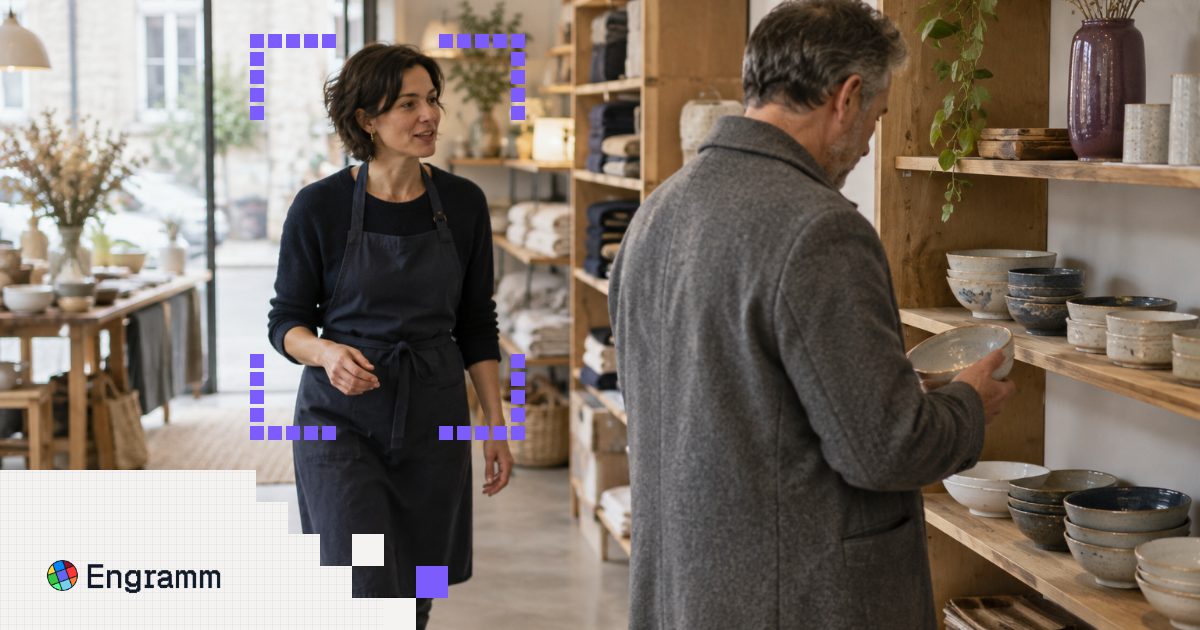
Saturday, 10:30 a.m., at a mattress store in a strip mall. A shopper walks in and stops at the mattresses on display near the entrance. An associate comes over: “Hi, can I help you?” She says she's just looking, he goes back to the counter, and twenty minutes later she leaves without having talked to anyone.
“Can I help you?” invites a yes or a no, and “just looking” is the easiest answer to give a stranger. Other associates, not wanting to seem pushy, wait for customers to come to them, and the customers feel ignored. An associate can also greet customers as they come in, let them find their bearings, then approach when they stop at a product, with a line about what they're looking at.
Each associate greets customers their own way, and the same associate doesn't greet people on a slow Tuesday the way they do on a Saturday with three customers waiting. The store manager's only measure is an occasional mystery shopper visit.
In short
A closed question asked too early gets “just looking”, and an associate who waits too long leaves the customer alone. The manager has no measure of the greeting.
What research says about greetings.
In 2017, marketing researcher Tobias Otterbring published a field experiment run at the entrance of a large bank branch. An employee greeted customers there, smiling at one group and keeping a neutral face with the other. Surveyed on their way out, the 210 customers in the study reported higher satisfaction when they had been greeted with a smile, and the effect lasted until the end of the visit. In 2008, Magnus Söderlund and Sara Rosengren had found the same result in an experiment with 220 participants, whether the employee was a man or a woman.
Otterbring advises training employees to express a positive attitude and creating a store atmosphere where it stays genuine. Both studies measure reported satisfaction, and the field study took place in a bank. We found no published study measuring how the way associates approach customers affects what they buy.
In short
A smiling greeting at the entrance leaves customers more satisfied until the end of their visit. The effect on purchases hasn't been measured.
The roleplay scenario.
The shopper is based on a profile from our page on retail sales associate training: the informed shopper, 42, who has compared everything online. Here, it's her second visit to the store.
| Element | In the scenario |
|---|---|
| Context | Saturday, 10:30 a.m., mattress store. Two associates on the floor, one of them at the register. |
| The shopper | Claire Leroy, 42. Back pain keeps her from sleeping well and she wants a new mattress. |
| What she says first | “Hi. No thanks, just looking.” |
| What she keeps to herself | She came in last Saturday with her husband and they tried two mattresses, but nobody took their name. She saw one of the two for $150 less on a retailer's website. She'll buy today if the mattress can be delivered before the 15th, when her in-laws arrive, and if the old one is hauled away. |
| The associate's goal | Make contact without rushing her, find out she has been in before and why she's hesitating, then have her try both mattresses again before talking price. |
The associate uncovers what she keeps to herself if they ask whether she has been to the store before and ask about her sleep. The price gap with the website comes up at the end; our use case on the price objection shows how to prepare a team for it.
In short
Claire Leroy comes back with a price she saw online and a deadline she won't mention on her own. The associate has to find out by asking questions.
A rubric for retail customer service training.
| Criterion | What to look for |
|---|---|
| First contact | A hello as she comes in, then the associate approaches when she stops at a mattress |
| First line | It's about what she's looking at and invites more than a yes or a no |
| Response to “just looking” | They let her browse, say where to find them and come back when she lies down on a mattress |
| Previous visit | They find out she has been in before and go back to the two models she tried |
| Discovery | Questions about her sleep, her current mattress and her deadline; paraphrasing before suggesting anything |
| Moving to a trial | They have her try both mattresses again before talking price |
| Manner | Distance, tone, smile, and a word to her when they have to help another customer |
Our guide to discovery questions gives examples of open questions, and paraphrasing is covered in our guide to active listening. Our sales roleplay scripts include another in-store greeting, in an appliance store, and how to run the debrief.
Template to download: in-store greeting scenario sheet and scorecard
The trainer's scenario sheet, with what the shopper keeps to herself and the variants, then the observer's scorecard, as a two-page PDF.
In short
The rubric follows the order of the scene, from first contact to the trial.
Greeting customers in Engramm.
In Engramm, the associate plays the scene by voice, or with a video avatar when the retailer wants to work on face-to-face contact. The scenario is built from your greeting standards and product sheets, then you vary the customers, for example a student in a hurry to furnish a dorm room before school starts. A session takes a few minutes, before opening or during a slow afternoon, and new hires can practice the greeting in their first week of retail sales training.
The scorecard uses your criteria, and the AI coach suggests other ways to open the conversation depending on the customer's profile. On the dashboard, the district manager compares results by associate and by store.
In short
The scene is played by voice or with an avatar, in a few minutes, and the dashboard compares the greeting from one store to the next.
Frequently asked questions.
How do you greet customers in a retail store?
Acknowledge them as they come in, with eye contact and a hello, then let them find their bearings. Approach when they stop at a product, with a line about what they're looking at that invites more than a yes or a no.
What do you say when a customer is “just looking”?
Take them at their word: “Sure, I'm at the counter if you have any questions.” Stay visible and come back when they linger over a product, with a piece of information or a question about it.
How do you train retail employees on customer service?
Have them replay the greeting with several customer profiles, using a rubric that scores the first contact, the first line, the response to “just looking” and the move into discovery. Short sessions before opening, repeated over several weeks, fit a store schedule better than a full day of training.
Sources.
- Tobias Otterbring (2017), “Smile for a while: the effect of employee-displayed smiling on customer affect and satisfaction”, Journal of Service Management, 28(2), 284-304: doi.org
- Magnus Söderlund and Sara Rosengren (2008), “Revisiting the smiling service worker and customer satisfaction”, International Journal of Service Industry Management, 19(5), 552-574: doi.org