Procurement negotiation training: preparing buyers for a supplier price increase
In a supplier negotiation, the salesperson across the table knows their costs and margins better than the buyer. This procurement negotiation training case prepares buyers for a supplier price increase: getting the breakdown, knowing which alternative to put forward and what to offer in exchange for a better price, without putting supply at risk.

- For
- Buyers, category managers, procurement managers
- Duration
- 5 to 10 minutes per simulation, before a contract deadline
- Skill practiced
- Preparation, questioning the supplier, trading concessions
The supplier announcing a price increase.
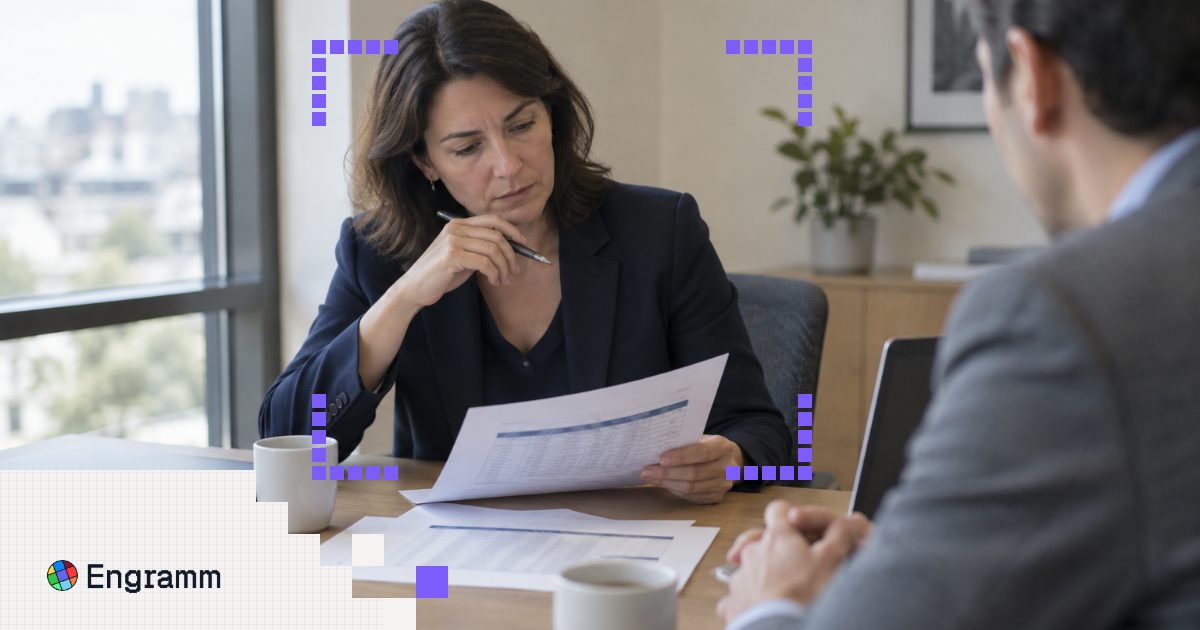
The negotiation starts with a letter: the supplier announces an 8% increase on January 1, cites rising material and energy costs, and suggests a meeting to “talk it through.” On the sales side, the same scene is covered in the use case on announcing a price increase.
Their salesperson has prepared the numbers and knows how long it would take to switch sources. The buyer has to hit a savings target without risking a supply shortage, and with no second qualified supplier, feels they have nothing to set against the increase.
The salesperson across the table may have practiced this negotiation, while the buyer rarely rehearses it out loud between two contract deadlines. The use case on how to defend your price with a professional buyer covers the other side of the table.
In short
The supplier comes in prepared, and the buyer has to hit the target without putting supply at risk.
Procurement negotiation training: what the research says.
Roger Fisher and William Ury called it the BATNA, the best option you have if no deal is reached (Getting to Yes, 1981). Our guide on how to close a sale covers it from the seller's side. For a buyer facing a single-source supplier, that option is built months before the meeting, by qualifying a second source for part of the volume or revisiting the specifications. On the day of the negotiation, they know how far they can go, and if they have no fallback, they avoid threatening to leave.
Leigh Thompson and Dennis Hrebec brought together 32 experiments in 1996 on what they call “lose-lose” agreements: on an issue where both sides wanted the same thing, they still signed a compromise that was worse for each of them. Facing a price increase, a volume commitment reassures the supplier and costs little to a buyer who will use that volume anyway.
Silence is one of the techniques of active listening, and it is also seen as a buyer's weapon: you stay quiet so the supplier fills the gap with a concession. In 2022, MIT's Jared Curhan and colleagues studied silences of at least three seconds in simulated negotiations. These silences went along with deals that were better for both parties, and the researchers found no sign that they help claim a bigger share. In one of the experiments, silence only helped the higher-status party.
In short
A fallback prepared in advance gives the buyer weight, and a shared interest, such as volume visibility, can be traded for a smaller increase.
Supplier negotiation: the scenario to play.
The buyer negotiates with a packaging supplier. Swap the industry and the numbers for those of your own categories.
The supplier
- Who he is
- Mark Delaney, key account manager at a corrugated packaging manufacturer. For six years he has supplied the three plants of a food manufacturer, a $1.5 million-a-year account.
- What he says right away
- “Our material and energy costs have gone up a lot. We'll apply 8% on January 1, like we're doing for all our customers.”
- What he keeps to himself
- The rise in his costs justifies about 4%. His plant is not running at full capacity and he wants to keep this customer. He can accept less in exchange for an annual volume commitment or an indexation clause tied to a public index.
The buyer
- What she knows
- The contract expires in six weeks. A second supplier is being qualified but cannot deliver for four months. Her goal is to keep the increase to 3%.
- Her goal
- Get the breakdown of the increase, put forward her alternative without bluffing, trade volume visibility for a smaller increase and close with written terms.
- The traps
- Accepting “like all our customers” without asking for the breakdown, threatening to leave when she can't, negotiating only the percentage and forgetting the effective date and indexation.
One variant puts the buyer in the final round of a tender, facing two finalists played by the AI, another one facing the only qualified supplier of a critical part.
In short
The supplier announces 8%, only half of which is justified by costs. The buyer has to get the breakdown and trade volume visibility for a smaller increase.
The scorecard.
Each criterion can be observed in what the buyer says, from the first exchange to the close.
| Criterion | What to look for |
|---|---|
| Preparation | She knows her target, the highest acceptable increase and the real state of her alternative. |
| Questioning | She asks for the breakdown of the increase and its indexes before discussing the number. |
| Holding the position | She doesn't move off her target without something in return, even against “all our customers.” |
| Trade-offs | Each effort on volume, term or schedule is traded for a smaller increase or indexation. |
| Listening | She lets the supplier answer and picks up what he says about his production capacity. |
| Closing | She sums up the rate, the effective date and what goes into the contract amendment. |
The AI coach in Engramm's negotiation training goes back over the moments where the buyer lost room to maneuver, such as an alternative revealed too early. Procurement managers see the gaps between buyers on the same team, criterion by criterion.
Template to download: supplier negotiation scenario sheet and scorecard
The trainer's sheet, with what the supplier keeps to himself and the variants, then the observer's scorecard with six criteria, as a two-page PDF.
In short
The scorecard follows the negotiation from preparation to close, including the trade-offs won.
Frequently asked questions.
How do you negotiate with a supplier?
Prepare your target, your limit and your alternative. In the meeting, get the supplier talking about their costs, look for what has value for them (volume, term, order schedule) and trade it for a better price, then close in writing.
How do you negotiate a supplier price increase?
Ask for the breakdown of the increase and the indexes it relies on, and compare them with how those indexes have actually moved. Then negotiate the amount, the effective date and an indexation clause, in exchange for trade-offs such as a volume commitment.
What is a BATNA in negotiation?
It is the best option you have if no deal is reached: switching to another supplier, making the part in-house, postponing the project. Roger Fisher and William Ury named it in Getting to Yes (1981). For a buyer, it sets the increase beyond which they won't sign.
How do you train buyers to negotiate?
With scenarios drawn from their own categories, played out loud and scored on a shared scorecard, a few weeks before a renewal or a tender.
Sources.
- Roger Fisher and William Ury, Getting to Yes: Negotiating Agreement Without Giving In, Houghton Mifflin, 1981, chapter 6: archive.org
- Leigh Thompson and Dennis Hrebec (1996), “Lose-lose agreements in interdependent decision making”, Psychological Bulletin, 120(3), 396-409: doi.org
- Jared R. Curhan, Jennifer R. Overbeck, Yeri Cho, Teng Zhang and Yu Yang (2022), “Silence is golden: Extended silence, deliberative mindset, and value creation in negotiation”, Journal of Applied Psychology, 107(1), 78-94: doi.org